Rosemary’s Baby (1968)

Rosemary's Baby

Before The Exorcist or The Omen, the original demon child movie was Roman Polanski’s classic, Rosemary’s Baby. Set in bustling New York City, the film draws out fear in an indirect manner. Rather than having memorable jump scares or gross gags, Polanski draws out the fear from realism; he uses human actions like manipulation and deceit that allows audience members to comprehend the true horror that’s taking place. Despite presenting a narrative that consistently builds up suspense, Polanski disguises the movie as a familiar narrative of new neighbor meets nosy neighbor. I love Rosemary’s Baby because it requires multiple viewings. You may seem to understand the movie at its conclusion, but there are so many technical details Polanski leaves for us to fish out.

It’s only appropriate that Rosemary’s Baby was released in the heat of 1968, a tumultuous year that saw growing social tensions reaching a boiling point—from the assassinations of Martin Luther King and Bobby Kennedy to the divisiveness catalyzed by America’s involvement in the Vietnam war. The movie portrays the national shift from the emphasis on American ideology to abandoning these values and taking matters into one’s own hands. And Polanski executes this through the eyes of Mia Farrow’s Rosemary, a character who we see transform from a naïve and subordinate 1950s housewife into a woman coming to grips with who her enemies are and trying to gain back control.

As is customary in plenty of Polanski films, the director pairs his narrative with a tension that progressively builds to a thunderous final act. And in a case of dramatic irony, we aren’t left wondering what the secret is—Polanski makes it clear to us by laying out the pieces of the puzzle—but instead, we’re left wondering how the inevitable will unfold and what will be Rosemary’s physical and emotional response.

The film takes place in the crowded atmosphere of Manhattan and Mia Farrow plays Rosemary Woodhouse, a dainty and passive housewife. Her husband, Guy (played by John Cassavetes), is a struggling actor looking for his big break. The sharp age difference between the two only further validates the subordinate role that Rosemary envelops. As soon as they move into the Bramford on the Upper West Side, they meet their invasive neighbors, Minnie and Roman Castevet (played by Ruth Gordon and Sidney Blackmer, respectively). As soon as Guy starts to become close with the Castevets, he mysteriously nabs a role in a play after the original actor is blinded under unexplained circumstances. Afterwards, Rosemary becomes pregnant following a night of hallucinations that depict a devil-like creature raping her (this is the closest the film gets in drawing out fear from the supernatural). We soon find out that Rosemary is pregnant with the spawn of Satan and the Castevets are ring leaders of a Satanic cult, having set their sights on Rosemary to unknowingly bring the Antichrist into the world.

Rosemary’s Baby stands out, especially today, because it occupies the backseat of today’s horror movies. Nowadays, we’ve become accustomed to everything that’s being released today, which primarily focuses on the jump scares and heavy gore. The fast pace of these Blumhouse-produced flicks serve no match for the calmly-paced films of the ‘60s and ‘70s that seamlessly paired horrific fantasy with realistic narratives. So then, why is Polanski’s film or The Exorcist or The Omen deemed such classics by movie buffs and film critics today? It’s because these movies allow us to become invested in whatever the protagonist is going through. Whatever Rosemary sees or feels, we experience the emotions with her. Polanski also takes the familiar surroundings of urban living to show us that this story can really happen.

Cinematographer William Fraker employs the use of mise-en-scène for the purpose of creating a realistic atmosphere. Also used prominently in Polanski’s next Hollywood feature, Chinatown, mise-en-scène refers to the entirety of any given shot or the expressive totality in one film image. As Rosemary and Guy are exploring their future apartment, the camera moves with them, traveling outside the frame of the initial shot and giving life to everything that surrounds the borders of the camera. These long and uncut takes help us become invested into the main character’s perspective and heightens the suspense by feeding us information in real time. A prime example of this is towards the end when Rosemary goes to find her newborn baby and sneaks into the Castavets’ apartment only to find a group of people sitting and chatting around a black crib. Although we know that this congregation is made up of Satan worshippers gathering to celebrate the birth of the Antichrist, we still are experiencing the same distraught emotions as Rosemary when the camera is following her POV.
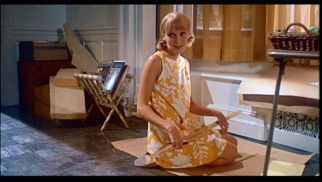
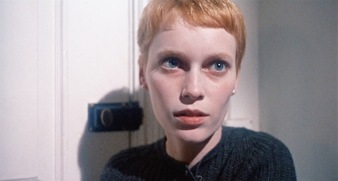
rosemary pigtails   rosemary pixie

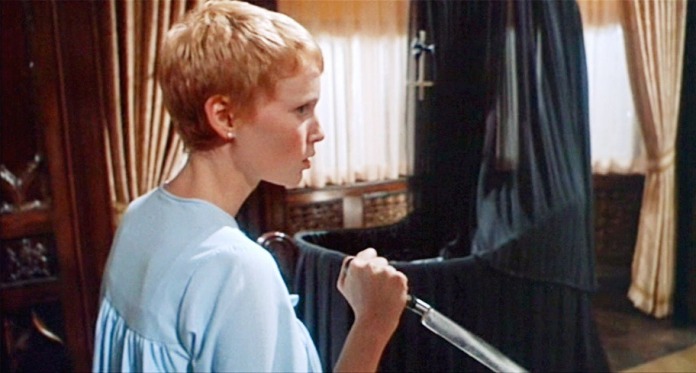
Rosemary’s physical transformation symbolizes the cultural shift that America observes during this social revolutionary period. In the first half of the film, we see Rosemary donning pigtails and fulfilling the role of common housewife plucked from the suburbs. She’s naïve and obedient to whatever everyone says around her. Without hesitation, she drinks the herbal drink that Minnie Castevet makes for her during her pregnancy. She passively complies over the fact that her husband practically rapes her unconscious body simply because he “didn’t want to miss baby night.” And Dr. Sapirstein (Ralph Bellamy)—the obstetrician recommended by the Castavets—informs Rosemary to stay away from books, disempowering her and thus fulfilling the role of the patriarchy. By the second half of the film, she cuts off most of her hair. When Guy disapproves of Rosemary’s haircut while she embraces it, it’s apparent that she’s seemingly rejecting the patriarchy and instead doing something for herself only, something that the ideal conservative family would frown upon. As the pregnancy pain increases, there’s a moment where a group of women at Rosemary’s party surround her and plead for her to see a regular doctor, Dr. Hill. This imagery serves as a parallel to the national notion of women uplifting each other during the era of the feminist critique. Although the inevitable occurs in the end, we see Rosemary making strides towards gaining some of the control that she never had in the first half of the film—she begins to read books, she dumps Minnie’s drinks into the drain, and she begins to trust her own instincts. Of course, this proves to be too little and too late when she finds out just what exactly her neighbors are and what their plot was. And for a second, it seems that she returns to her old conservative ways when her maternal instincts kick in and she begins to rock the crib of her newborn baby. However, I see this scene as an ending that shows Rosemary fully embracing the control that she’s regained. She is not forced to care for the baby—she chooses to and this is symbolized by the last shot of Rosemary smiling down at the baby.

Rosemary’s Baby oozes fear by not showing us what’s there. Polanski leaves it to the audience members to deduce what’s taking place next door, or what Guy is up to when Rosemary is not with him. Setting up the camera so that it follows Rosemary, we mainly watch the movie through Rosemary’s eyes. When we’re not watching her perspective, we’re looking at her and her expressions. A classic example—and one that’s definitely studied by film teachers everywhere—is the memorable scene in which Rosemary approaches the crib to see her baby for the first time. All we see is Rosemary’s eyes widen as she dramatically covers her mouth with her hand in utter terror, and all we hear is this booming invasion of horns that lets us know what exactly is going on inside Rosemary’s head. Polanski’s conscious decision to not show the baby is one of cinema’s great twists. As a viewer, we expect to see whatever is making the protagonist recoil in total fear. But Polanski allows the viewer to conjure up the image themselves, believing that the human imagination is far scarier than whatever can be presented onscreen.

Roman Polanski succeeds with Rosemary’s Baby because he is able to take an absurd premise and make it so believable. By placing Rosemary in the center of our periphery, we are able to go through all of the suspicions with her. We follow her all the way through the ending, an ambiguous one that haunts me to this day.

CONSENSUS: 4 out of 4 tannis root pendants


Standard

mother! (2017)

mother!

SPOILERS!

Every now and then, a film comes along that dares us to do the unthinkable: to think. A movie normally lays out its premise for the audience and allows the story to unfold before the final scene ties everything together or leaves off with a cliffhanger (Halloween and Friday the 13th film franchises, I’m looking at you). But Darren Aronofsky, a renowned filmmaker with plenty of credibility in the industry, completely flips the script on what a movie can be. He uses his heart-wrenching and feverish concerns for our world to create a metaphorical piece that disguises itself as a psychological horror film. Entitled mother!, the movie initially has a simple premise where it seems like we’re witnessing a conventional home invasion thriller. But it’s more than that—IT IS SO MUCH MORE THAN THAT. To put it mildly, the film is essentially an exercise in mind-fuckery, an “assault of the senses” that left me weak in the knees as I left the theater. Not since I saw Inception at the movies has a film made such an impact on my thoughts. But unlike Inception, mother! forced me to reflect on humanity and how we are contributing to our own demise. At the center, the film is about the natural characteristic of human greed; Aronofsky illustrates this theme using biblical allegories, specifically events from the Old Testament and the New Testament.

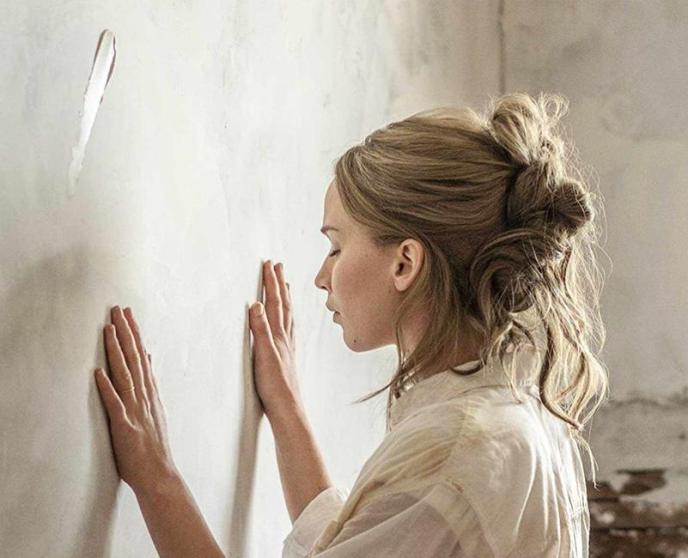
At first glance, mother! has a non-convoluted setup: an attractive couple are living peacefully in a grand old house in the middle of nowhere until an uninvited older couple shows up and then things go awry. Simple, right? False. Because no character in the film has a direct name and everyone refers to each other using pronouns, we are free to interpret what each character represents. Jennifer Lawrence is meant to embody mother Earth, hence the title of the film. She is physically connected to the house (the house represents the world) as she walks around barefoot—a conscious choice made by Lawrence to emphasize her purity—and is able to envision the house’s literal beating heart every time she places her hands onto the walls in a meditative manner. Javier Bardem, meanwhile, is meant to play a form of God, a creator/author who gave rise to everything we see in the film, but also is suffering from writer’s block and trying to create his next masterpiece. They are alone in this big house, and we get a sense of their isolation thanks to director of photography Mathew Libatique’s beautiful cinematography, one where the camera follows the back of the characters to dizzying yet adventurous effect. We see this prominently right after Lawrence wakes up and wanders around the house; the sounds of Lawrence’s footsteps combined with the creaking floorboards and the breeze billowing outside the walls create this peaceful yet lonely atmosphere.

The couple’s serene isolation is interrupted when there’s a knock at the door one quiet night. Remember, Bardem embodies the God/Creator figure. Therefore, notice how right before we hear a knock at the door, something clicks in Bardem’s mind and he quickly writes down his thoughts; whatever he is creating on that piece of paper is brought to life as man, played by Ed Harris, walks through the door. A self-proclaimed fan of Bardem’s “work”, man (or Adam) is drawn to a crystal that’s placed on a pedestal during the first minute of the film. His wife (or Eve), played by Michelle Pfeiffer, appropriately arrives after we witness the scar on Adam’s rib the night before (the Book of Genesis states that God took Adam’s rib and made out of it a woman, Eve). She too is drawn to the crystal on the pedestal. By now, it’s clear that the crystal resembles the “forbidden fruit” that hangs from the Tree of Knowledge. While Bardem continues to plead with man and woman to not touch it, they ultimately disobey and unsurprisingly shatter it into bits and pieces, infuriating the Creator and making Him banish man and woman from the “garden.”

Adam and Eve’s two children (Cain and Abel) then barge into the house incessantly arguing. Their back-and-forth bickering culminates in Cain killing his brother. Arronofsky reenacts the original sin to showcase the blatant truth about humanity. As beautiful as mother makes the world out to be by tending to the house and making sure its resources are plentiful, it is ultimately a place not meant for coexistence amongst humans as evident from murder occurring within family, something that’s built on love. The state of the house is presented as mother again places her hands on the walls and observes its beating heart has deteriorated into a gray color. There’s also a bold blood stain on the wooden floor that mother can’t remove despite all of her efforts—it just remains stagnant, staring back at her. When man and woman decide to hold a vigil for their murdered son, unfamiliar faces start to make their way into the house, much to mother’s annoyance and confusion. The guests stop behaving like guests and begin to make themselves too comfortable, filling the house with corruption that’s ultimately cleansed by a sink pipe that’s burst open; this is meant to represent the Great Flood as it expels all of the humans out of the house, or the world. This concludes the first half of the film, or the Old Testament.

After man and woman and their guests are vanquished from the house, the calmness and relief is slowly stored back into mother’s gaze. At this point in the film, mother resembles the character of the Virgin Mary. As soon as the words “I’m pregnant” are muttered by mother the following morning, we are able to predict Aronofsky’s intention in retelling the effects of the life and death of Jesus, aka the New Testament. The Creator, upon hearing the news, instantly jumps out of bed and writes down his brand new masterpiece. For the first time in the film, we see the Creator cherishing mother the same way she has been cherishing Him throughout the movie, which probably hints at an insight into their relationship: mother truly loves her husband and is willing to do anything to keep him happy, but the Creator only seems to pay any mind to His wife’s unwavering love when she advances and fuels his mentality to write something that will propel his notoriety—this is an important detail that helps shape the ending.

Some time passes by and mother is preparing to give birth when the Creator’s finished work is published. To celebrate this achievement, mother prepares a celebratory dinner for just her and her husband. Receiving word of His book selling out, the Creator temporarily abandons His wife and greets a mob of fans that have surrounded the house, asking for autographs and revering His simple presence. Back inside, mother barricades herself as fans start to casually let themselves in. The shaky camerawork that follows Lawrence creates relentless fear that’s characterized by crippling anxiety as she spins around the house finding a plethora of foreign faces. From the perspective of a woman pregnant with her first child, this is terrifying to witness. As more and more people swarm into the house like bees, the scene descends into chaos as every human takes objects for keepsakes and corrupts the environment that mother has devoted her time to in perfecting. Different people coming in means different perspectives too, which obviously leads to violence. What was once a vessel of serenity and beauty in the beginning of the film has now turned into a war zone. Mother helplessly navigates herself through rooms we can’t even identify anymore because of the damage that the humans inflicted upon the house.

Mother then goes into labor and the Creator guides her to a private room that is surprisingly left intact. She is able to give birth with thousands of the Creator’s followers hovering around the room. Wishing to stroke his own ego, the Creator takes the baby from sleeping mother and presents him to the crowd, despite mother’s incessant pleas not to. What transpires is a horrifyingly graphic sequence not meant for the fate of heart; this scene alone is the reason why pregnant women should stay away from mother! The baby is seen being carried by the sea of people, who then inadvertently snap his neck, which alludes to the crucifixion. Jennifer Lawrence’s reaction in this sequence is so raw that she started hyperventilating, cracking a rib in the process. When she comes across her baby’s mutilated body, her reaction is that of pure terror—her pain and mortification is so palpable through the screen that it’s a shame the Golden Globes overlooked her performance.

Catapulted into a fit of rage, mother’s broken heart appropriately causes the floorboards to break apart as she makes her way down to the cellar. Ignoring her husband’s pleas, mother sets fire to the oil tank and destroys everything entrapped in the Garden of Eden, including the people, the house, and the plant life outside. The Creator, however, is left unharmed and carries mother’s badly burned body. When she tells Him in a gut-wrenching voice that she has nothing left to give, the Creator asks for her love and He physically pulls out her heart from her chest. As mother turns to ashes—her heart was what kept filled her with life—the object in the Creator’s hands breaks down like coal and the crystal object is revealed again. Like the first minute of the film, the Creator places the crystal on the pedestal and the whole setting is once again renovated, but this time, a new mother fills Lawrence’s shoes. After catching a glimpse of her face, the screen cuts to black as we sit there pondering about the cyclical narrative this movie just touched base upon. The only song in the movie, Patti Smith’s cover of The End of the World, begins to play and hauntingly ties up everything we just witnessed.

The way that Darren Aronofsky presents this movie is a testament to the human nature of compassion and comprehension. He creates this allegorical piece where mother Earth is a living and breathing woman, played by a vibrant, young Jennifer Lawrence. It’s the only way that we humans can understand how we are mistreating Earth through our wars and our self-absorbed tendencies to consume. Because mother earth is human in this film, it’s easier for us to express empathy and sorrow for her because we see the physical abuse/trauma she endures and the strangers that walk all over her—the emotions are there and Jennifer Lawrence brings humanistic qualities to something that arbitrarily surrounds and supports us. Aronofsky is scorning us for being so unrelenting to our home. We see how mother gives and gives throughout the film with the use of mobile limbs and affection expressed through her visible face. But because mother Earth isn’t actually this divine human being and instead the “water” that surrounds us, we take her for granted by polluting her airways, destroying her natural creations, and creating conflicts that lead to bloody war.

Regarding the cyclical nature of this story, I think it’s important to comment on the meaning behind the crystal that originates from within mother’s heart. You see, we are lead to believe that God is solely responsible for everything we see in the film—from mother to the setting to humanity, etc. However, he is unable to recreate these in the first place without mother’s love. Referencing Shel Silverstein’s The Giving Tree, Aronofsky states that mother’s love and support is omnipresent—always giving—and is represented by the crystal that is placed on the pedestal. Without a foundation to build life on, God is powerless without mother and requires her heart to catalyze a new creation cycle. When a new mother awakens in the bed in the final shot of this film, this is meant to signify the dawn of a new creation cycle, one where Earth continues on after the period of humanity. While it’s hard to imagine an Earth existing without humans in the far future, all it takes is a review of the prehistoric era—and how giant reptiles were completely decimated by a meteor—to comprehend how Earth is able to replicate new life in different manners. As Aronofsky points out, “It won’t be our story anymore.”

Darren Aronofsky is able to use his creative panache to tell a cautionary tale about humanity by applying conventions that make for a heart-racing and terrifying ride. He illustrates this disturbing reality using intricate camera work that perfectly captures the perspective of an innocent wife and mother. There’s a lot of pressure on Lawrence’s shoulders throughout the film and she handles it extremely well as she expresses emotions ranging from cheerful bliss to sheer terror. Michelle Pfeiffer, who plays the metaphorical Eve in the first half, steals the show when she amps up the enticing behavior of Eve.

The allegory presented in this film is no code that requires several viewings in order to unlock the meaning behind it. However, it’s an interpretation that forces the viewers to evaluate themselves and their tendencies of self-righteousness. Mother! pinpoints the absurd manner in which we live our lives—worshipping false idols, claiming whatever we want as ours, creating war—and cautions us that this trend is bound to cause our demise. This film will not sit well with everybody and it shouldn’t, but man, hats off to Darren Aronofsky for conjuring up something that does everything it’s meant to do by making us think and converse.

CONSENSUS: 3.5 out of 4 murderous Kristen Wiigs

Standard

The Beguiled (2017)

beguiled

SPOILERS!

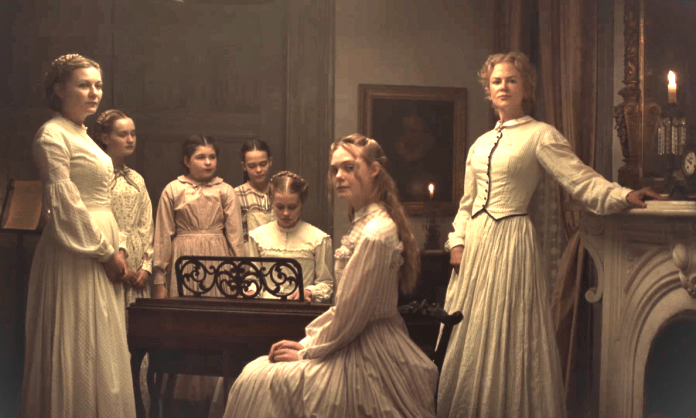
 The Beguiled opens with a beautiful shot of a spacious forest. As the camera pans in and around the area, the viewer is allowed to get settled in and transported to a different time period. Not an uncommon trademark for the director, long and drawn-out shots are aspects that Sofia Coppola incorporates into her films in order to help familiarize the audience with the film’s setting. With zero music, the title of the film is presented in outlandish pink letters in the middle of the forest—reminiscent of old-school Hollywood opening credits. As Coppola takes her time in offering the forest to our eyes, a young girl with braided hair appears as she walks along the way and picks up mushrooms. Throughout this, we mainly see the back of her while our ears are filled with the background noise of birds chirping, trees billowing in the breeze, and weapons firing in the distance amidst the Civil War. Not being able to identify the young girl in frame combined with the foreign sounds in the background make for an eerie sequence that only further captivates our attention. While picking for mushrooms, the girl—named Amy (Oona Laurence)—encounters a badly wounded Union soldier, Corporal John McBurney (Colin Farrell). After some initial hesitation from Amy, she helps McBurney up as he leans onto his innocent companion and hops his way onto Martha Farnsworth’s girls school, led by the stern and strong-willed Ms. Farnsworth herself (Nicole Kidman).

Before McBurney arrives at the school, Coppola shows us what life is like within the confinements of this institution. Some of the girls are tending to the gardens, while the others are reciting words in French back to Edwina Morrow (Kirsten Dunst), a teacher in Ms. Farnsworth’s school with eyes that seem to long for something outside the walls. Alicia (Elle Fanning), one of the older teenage girls with palpable hormones, is the only one that seems to know what she wants yet is aware that she can’t attain it. And yet, her prayers are answered when McBurney stumbles onto the doorstep unconscious, simultaneously sweeping the air out of the surrounding space and thus sending Alicia’s hormones through the roof. I love the way Coppola so clearly shows the effect of McBurney’s arrival. His abrupt presence decimates the monotony that seems to be swirling within the school for quite some time. For four years, these women have been so isolated and so cooped up in their daily routines that they’re practically revived by the arrival of not only a new guest, but a seemingly vulnerable male soldier. The women have more intent in their voices as they discuss what to do with McBurney’s unconscious body. Alicia’s bored expression is transformed into an attentive one as she continuously glares at this vessel of masculinity lying on the porch. The younger girls stare on with fascination, while the older women—Martha and Edwina—slowly but surely become attached to McBurney. Sofia Coppola is able to progressively build up the sexual tension throughout the course of this film. In one of the first instances, Martha sponges McBurney’s wounded body. A scene that required two hours to film, Coppola uses the natural afternoon sunlight to emphasize McBurney’s masculine body and to help awaken Martha’s suppressed sexuality. Martha quickly brushes off these urges and focuses on the task at hand. However, the inevitable takes places as all of the women in the house begin to vie for the soldier’s affection.

The younger girls begin to huddle by the door, while Martha and Edwina engage in romantic talks with the soldier. Not only is he able to win the women over with his good looks and charm, but the Corporal uses empathy as well to connect with them on an emotional level. Someone who’s in serious need of care, McBurney turns the tables on Edwina by asking her about the one thing she desperately wants in her world. As Edwina drifts into a monologue about her desire to leave the school and start her life anew, McBurney listens intently and lends his sympathy towards her in a romantic manner; he holds her hand and hypnotizes her affection with piercing eyes. As the women of the house begin to yearn for the corporal’s attention, they create a humorous situation in which they all begin to decorate themselves with extravagant accessories or colorful dresses that accentuate their femininity. There’s a hilarious scene in which everyone is sitting at the dinner table and each of the women begin to claim ownership over the apple pie that McBurney emphatically devours; Alicia points out that she made the pie, then Edwina cuts in and says it’s her recipe that Alicia followed, and then Amy highlights how she was the one who picked out the apples. These back and forth exclamations are fun to watch and the pettiness displayed onscreen between the actresses is ridiculously amusing.

While we find these initial scenes to be entertaining, it’s important to note that while each girl presents herself to the soldier in a flirtatious manner, the others take notice. Gradually, the audience becomes aware of the tensions that start to heighten due to the women’s apparent stern faces paired with jealous eyes. This tension ultimately culminates in a matter of a few seconds. Sofia Coppola takes a single shot of Alicia and McBurney fooling around in bed and pairs that with the audible gasp of a crushed Edwina who stumbles upon them. It is in this instance that Coppola showcases a drastic shift in the tone; in an instant, the movie jumps from the tone of a lighthearted yet intimate narrative to a thrilling and soap opera-like endeavor. Heartbroken and fooled by her discovery, Edwina throws herself into a fit of rage. As McBurney tries to console her, Edwina’s rage gets the best of her as she shoves him down a spiral staircase, damaging his injured leg for good. Up until this point, it seemed that the women were drifting apart from each other due to the growing emotional attachment each of them possessed over the Corporal. But Coppola is able to bring them back together and help emphasize that this isolated house in the midst of a civil war is a domain for female empowerment. The women of the house take drastic measures for they notice the extent of the damage to McBurney’s leg, ultimately amputating it while he is unconscious. When McBurney makes the vile discovery, he descends into hyperventilation and goes mad with fury, threatening the women with a gun.

Throughout the movie, I notice the control that McBurney subtly seeks over the women and Coppola brings that into the light through the theme of gender roles. Taking place in the 1860s, The Beguiled clearly establishes the role that men and women played back then; men played the soldiers, and women the homemakers. Men were authoritative and women were deemed the inferior sex. When weak and badly wounded Corporal McBurney arrives at Miss Farnsworth’s school, he mentally feels so small compared to the women; they are the ones in control of his fate and he serves no authority over them. Therefore, McBurney subconsciously resorts to methods of seduction over the women in order to garner his status of male dominance. Through the use of physical contact and deep soulful gazes, McBurney slowly ties a metaphorical leash around the group and becomes such an engulfing fixation in the women’s minds that they all turn their attentions towards pleasing him. Thus, the corporal is able to use his injury to his advantage by establishing his alpha male role within the household. And once he loses his leg, he goes on a rampage by waving his gun in the women’s faces, petrifying them as if his authority is hanging by a thread in the household. Because the women have taken away his leg, McBurney, at this point, is desperate to cling onto his manhood. While everyone is frightened out of their wits by his behavior, Edwina is the only one that doesn’t seem fazed as her libido continues to sizzle. She runs after him and they have passionate sex on the wooden floor in the guest room. After this, it seems that McBurney has yet again tightened his grip on the women in the house for he shows up at dinner later that night with a cheery disposition and Edwina’s arm locked in his grasp. Of course, the audience knows this is to be short-lived as a use of dramatic irony lets us know that the mushrooms the Corporal is about to eat were poisoned by Miss Farnsworth and her students. Much to Edwina’s heartbreaking dismay (she finally seems to have someone in her life that breaks the mundane cycle of the academy), McBurney collapses onto the floor as Farnsworth and the rest of the girls look on with no regret in their pupils. Despite the devastation in Miss Morrow’s eyes, she helps everyone else sew Corporal McBurney’s body into a shroud the next morning and stays behind with the women she’s known for the past four years.

The Beguiled has proven to be about a lot of things. Yes, it’s an intimate look into the repressed sex drive during a certain time period where men were off at war and women awaited some sort of resolution. And yes, it’s an interpretive look into the emphasis on gender roles and how some of the characters subconsciously mold them. But most importantly, it is also about the house where the entirety of this film takes place—the nifty details, the sun’s hues catching its borders, and the grand furniture that sets up the scenes beautifully. There’s an elegance in which the characters move throughout the house that I sometimes felt like I was watching a Broadway play. The house significantly highlights its female presence. “Established” gender roles don’t exist here and the women are able to prove, throughout their screen time, how powerful they are. When they stick together, they are extremely resourceful. They are willing to claw each other’s eyes out for McBurney, but yet that’s the thing, they all pursue something they lustfully desire—something that that time period’s society would heavily judge. And when they encounter a threat, they rely on each other to vanquish their unwanted guest. Like I’ve said before while watching other Sofia Coppola films, we see what she sees. The final shot is a testament to this, where all of the women sit on their front porch and look out into the distance after discarding McBurney’s body. The camera positions itself behind the gates that stand in front of the front porch steps. As the audience continues to look into the gaze of each woman, a sense of intimidation exudes through the screen for they hover around the house like lionesses defending their territory.

The Beguiled is not for everyone. Its pace might be slow and dragged out, but if you admire Sofia Coppola’s visual flair like I do, then you’ll certainly relish her meticulous shots. And if you have patience for those moments of uncanny silence, the film will prove to be a riveting tale of lust and human nature that’s truly highlighted by its masterly performances and grand cinematography.

CONSENSUS: 4 out of 4 horny Elle Fannings

Standard

Manhattan (1979)

queensboro

SPOILERS!

When watching a film for the first time, we delve into an alternate universe where a story is conjured up and presented onto a screen in front of our eyes. However we react to it, a movie leaves a lasting impression on us. From then on, we associate said movie with certain adjectives or the thought of it causes us to reminisce the emotions and state of mind that the film evoked. Thus, it’s no surprise that we tend to rewatch movies and deem them our favorites. We rewatch for we wish to revisit. We wish to relive the memories. We wish to return to the characters we fall in love with and the characters we love to hate. We wish to absorb the witty or insightful dialogue. We wish to trade in reality for a world where time doesn’t exist. That’s where Woody Allen has been so effective. Time and time again, he has been able to create worlds where the characters are so vividly written, the jokes are a-ha one-liners, and the situations revolve around realistic themes of love and loss. That’s why his films are such classics.

In 1977, Allen was catapulted into international stardom with his unconventional rom-com, Annie Hall, that went onto capture the Oscar for Best Picture. Some may view Annie Hall as Allen’s love letter to New York City as he showcases a romanticized view of the Upper East Side, but he never addresses New York City the way he does in the opening sequence of Manhattan—a movie that has a divorced writer falling in love with his best friend’s mistress while dating a teenage girl. All of the events in the film take place in, you guessed it, Manhattan.

The opening montage navigates through a collection of New York City landscapes. While this is happening, the background noise is filled with George Gershwin’s epic composition, Rhapsody in Blue, which uncannily captures the aura of this lively city; Woody Allen needs just this montage and Gershwin’s piece to significantly describe the indescribable New York City. He distributes Manhattan on a platter, overwhelmingly feeding the audience beautiful, crisp shots garnished with mesmerizing music.

The film starts off by introducing us to Isaac Davis (Woody Allen), an observant yet neurotic person. A twice divorced 42-year-old man, Isaac has nonchalantly developed a relationship with a precocious 17-year-old girl named Tracy (Muriel Hemingway—Ernest Hemingway’s granddaughter). While their ages are on opposite sides of the spectrum, so are their outlooks. Isaac is a bit self-centered and seeks pleasure in order to satisfy himself, yet Tracy yearns for an ideal relationship—one where both halves complement each other; she attempts to accomplish this by paying great attention to Isaac’s interests and suggestions and making them a part of her life. Tracy’s youth is clearly reflected through her naïveté. Because she is so inexperienced in the world of love, she behaves with Isaac as if they’re going to spend the rest of their lives together. This, of course, means that Isaac is to blame for attempting to inspire a relationship with someone far inferior in age and experience. It seems he knows that she is far too young for him, but Isaac is the one who ends up the immature one for he says such meaningful and unique sentiments to the 17-year-old and then decides to discard her in favor of some older and mature woman. Tracy’s innocent heartbreak is acted out so well while she’s sipping soda through a straw that Muriel Hemingway is able to display such an impressive range of emotion for someone so new to the acting world.

This film doesn’t just explore Isaac’s relationship with Tracy, but also his relationships with relationships. His sophisticated personality is no match for his true feelings when it comes to dating and thus he finds himself raveled in a cyclical mating dance—one where he experiences his fair share of euphoric highs and devastating lows. All of the supporting characters seem to be entangled in Isaac’s ill-fated narrative of love and loss. His ex-wife (Meryl Streep) divorces him and finds companionship with a woman, which results in her urge to write a tell-all memoir that chronicles details about Isaac and the factors that led to the demise of their relationship. Yale (Michael Murphy), Isaac’s close friend, is cheating on his wife and having an affair with Mary (Diane Keaton), a woman who comes off as extremely intelligent and opinionated despite having her fair share of insecurities. After Yale seemingly “dumps” Mary, he urges Isaac to pursue Mary; this simple notion results in Isaac dumping Tracy and chasing down Mary.

The same way that Sofia Coppola writes her love letter to Japan in Lost in Translation, Woody Allen does the same to New York City in this film. From the opening montage to the final shot of Manhattan’s skyscrapers, Allen successfully depicts the aspect of finding love in the city. The Queensboro Bridge at night. Chinese food in bed. Ventures into the Guggenheim Museum. Strolls in Central Park. These are all landmarks and meticulous quirks that not only resonate with a New Yorker, but also invite foreigners into this crowded urban environment which leaves them longing for this adventurous lifestyle. On a technical level, the lasting effect created by Manhattan is contributed to the use of widescreen black-and-white cinematography. The lack of any vibrant colors helps encapsulate the aura of New York City; this American landmark exudes such sophistication and timelessness that it doesn’t need color to show off its legacy. Gordon Willis’ crisp lighting also allows the characters to truly pop out of the screen. For example, the scene where Isaac and Mary sit on a bench beneath the Queensboro Bridge at five in the morning is so vividly filmed and displayed that that single shot could easily be framed and admired at a museum. In another scene, Tracey and Isaac are conversing at Isaac’s apartment. Of course, it would be expected to place the couple at the center of the screen, underlining them as the focus of the scene. Instead, Woody Allen places them at the left bottom corner of the shot and Willis highlights them in a circle of light that is juxtaposed with the completely dark remainder of the apartment; this is meant to get the point across of what Tracey brings to Isaac’s somewhat mundane life. In one of the stranger scenes, Isaac and Mary arrive at the Guggenheim after being soaked in a storm. They are seen walking through an exhibit that depicts galaxies in space. As they delve deeper into the exhibit, the light starts to disappear until we’re left with a dark background and two characters recognized by their silhouettes. It is in this instance where Willis forces the audience to focus on the two characters on the screen and the dialogue that they exchange. With a soft-spoken conversation and the short physical gap between them, it’s no arduous task to find the chemistry that Allen and Keaton so obviously share.

One of the more impressive turnouts from this film is how well it is able to distance itself from Allen’s previous film that propelled him and Keaton into infamy—Annie Hall. Released in 1977, Annie Hall had elements that were shared in the 1979 feature; both films took place at the heart of New York City and both chronicled the beginning and demise of a relationship between Allen and Keaton’s characters. While Annie Hall primarily focuses on Alvy and Annie and their journey, Manhattan solely focuses on Isaac. Isaac’s age may validate his maturity, yet the film shows evidence of the opposite. Like many younger people, Isaac doesn’t know what he wants, which is why he is so quick to pounce on the potential of a blooming relationship when he has the chance. As soon as Yale gives him the green light, Isaac pursues a relationship with Mary that was initially successful because both characters were alone. And then you look at Mary who Diane Keaton plays with ferocious precision. Some viewers may see Mary and Annie as two identical people, but what they’re really paying attention to is Ms. Keaton’s noticeable traits and quirks that personify her; it’s the same with Kristen Stewart and the way that her aloof and awkward mannerisms always single her out in the roles that she plays. Anyway, Mary comes off as much more sophisticated—or at least, that’s what she wants everyone around her to think as she consumes her dialogues with rants about things like Freudian psychology or honesty. Much like Isaac, she’s lonely yet she tries hard to avoid this characterization. After she breaks things off with Yale, Mary falls into Isaac’s arms. Once Mary realizes how lonely she still feels with Isaac though, she falls back into Yale’s arms. It could be Mary’s preferences or it could just be her loneliness that she vows to escape.

What I like most about this film—and in general, all Woody Allen films—is that it doesn’t follow the traditional formula of a romantic comedy; it doesn’t gloss over real-life situations with sappy dialogue or heartfelt reunions towards the end. In a perfect—and frankly, abnormal—world, boy meets girl. Boy and girl fall in love and live happily ever after. The end. No. Unfortunately, real life is not as straightforward as that and Woody Allen is pretty darn aware of that. We experience different characters in our world every day and Allen makes sure he incorporates these unique personalities into his narratives. For example, Isaac is never seen as a romantic or a heartthrob; instead, he acts and speaks upon instinct, even when his instinct tells him to do something selfish. Rather than encouraging precocious Tracy to study in London, he pleads for her to stay in New York with him. Despite being 17, Tracy is mature beyond her years and with her upbeat yet calm demeanor, she is able to let Isaac know that their time together has run its course with a simple line: “You have to have a little faith in people.”

And with all of that, Manhattan serves as the backdrop to these multiple narratives. New York City is so apparent in this film that it’s almost its own character thanks to Gordon Willis’ sharp photography. Wherever the characters converse, Manhattan surrounds them. Manhattan’s scenery brings the characters closer and more intimate. And when Isaac frantically runs to Tracy’s apartment in the end, Manhattan’s wide streets only accelerate Isaac’s urgent pleas towards Tracy. With this film, Woody Allen is able to truly emphasize New York City as an inescapable and everlasting presence in our lives.

CONSENSUS: 3.5 out of 4 cancer-causing frankfurters


Standard

Suspiria (1977)

suspiria pic

SPOILERS!

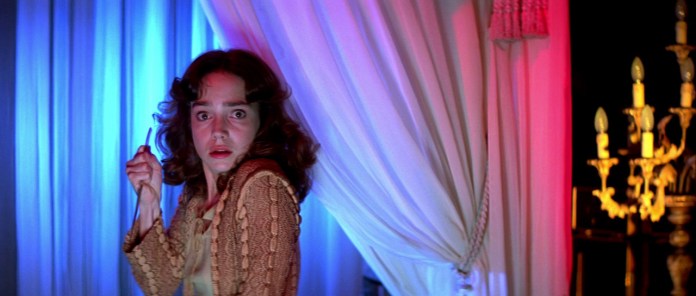
Horror has always been a film genre that’s drawn me in. For some reason, I love the prospect of getting scared while watching something fictitious. Perhaps, it’s the infinite amount of ways that a scary movie can reach out and grab you. Or maybe, it’s the lingering effect of walking out the theater after the movie’s done and feeling the numbness in your legs or the fear brushed over your skin. Whatever it is, horror films are effective and there are many adjectives that remain synonymous with them; they can be terrifying, gory, eerie, spine-tingling, unnerving, shocking, etc. All of these words can apply to Dario Argento’s 1977 classic, Suspiria, but there is one word that truly defines it: beautiful. When one talks about masterpieces, one refers to pieces of art that showcase the craftsman’s raw talent on display. Argento showcases his masterpiece by using bright and lush colors that depict a kaleidoscope nightmare. Visually, Suspiria is beautiful; the setting is beautiful, the lighting is beautiful, the cinematography is beautiful…even the death sequences are beautiful albeit grotesque. After all, It’s no surprise that Argento models this film’s color scheme after Walt Disney’s Snow White and the Seven Dwarfs.

Much like Snow White, Suspiria plays out like a folk tale—its main protagonist must evade the wrath of witches. That main protagonist is Suzy Bannion, played by Jessica Harper, who travels to Germany to attend a dance academy. As soon as she arrives at the airport, she is greeted by a violent thunderstorm that almost serves as a warning for her. At the academy, Suzy finds out the school isn’t what she expects; students are disappearing, maggots fall from the ceiling, and Suzy herself faints on her first day of class after encountering a haggard custodian lady. Suzy soon discovers the academy houses a cult of witches and she has to either survive or become its next victim. While the plot is fairly simple, each aspect of Suspiria is malicious. From the opening thunderstorm to the overly violent death scenes, this film is presented as 100 minutes of unescapable hell.

For a film that deals with such dark matter, Suspiria is surprisingly bright in color. During scenes of suspense or anticipating dread, the darkness is replaced with bright blue and red colors. The film’s first death sequence shows a frantic student, Pat, running from the academy to her friend’s apartment. The apartment is so outrageously showy that the viewer almost forgets that Suspiria is a horror movie. As Pat is lured to a window, she is smashed through it by an unseen figure and violently stabbed. One shot shows the knife being plunged into her visible heart; this shot evokes a sense of gratuitous discomfort, yet Argento continues to mesmerize the audience by juxtaposing this image with polished and inviting colors. Pat is then hung from a telephone wire and shatters through the stained glass ceiling. The colorful shattered glass combined with the bright red dripping blood paints an image that is so pleasing to the eye, but is achieved so brutally.

The film is also characterized by its juvenile vibes. As soon as Suzy enters the academy, she is greeted by instructor Miss Tanner, who is very reminiscent of Miss Trunchbull from Matilda. Miss Tanner and Madame Blanc, the vice-directress, fulfill their roles as witches from the get-go when they compliment Suzy on her youthful beauty. In addition, the other students in the academy are very petty towards the protagonist and the school itself has doorknobs positioned at the same height as the actress’ heads—a move that Argento makes in order to heighten the students’ naïveté as the actresses had to raise their arms to open the doors, just like children would. After the discovery of maggots, all of the students are forced to sleep together in the practice hall like kids at a day care. By incorporating imposing figures and architecture in the dance academy, Argento emphasizes the fear and intimidation that this nightmarish setting is able to exude.

Suspiria’s theme music is the type of music that you don’t know you know until you’ve heard it (I hope that makes sense). Composed by Italian progressive rock band, Goblin, the film’s composition is first heard in the opening scene. Starting out with a xylophone, the theme initially sounds like an innocent music box, which is appropriate to the film’s characters and setting. But as breathy vocals are incorporated, the feeling of unease sets in. Hypnotic instruments like the tabla and bouzouki are gradually added on, which make it apparent that something sinister awaits Suzy. In other scenes, Goblin uses the intense banging of drums to mimic the sound of a heart beating rapidly. It’s a terrifying assault to the ears, mainly because it pairs with the film’s ghastly imagery so perfectly and sets the audience members on the edge of their seats.

While Suspiria exceeds in garish style and atmosphere, it succumbs to formulaic horror movie tropes and a dated quality. There are so many instances where characters investigate strange noises or venture into the unknown that there is no use in counting on their survival. But perhaps that’s what Argento is aiming for—campiness. Campiness is what engulfs our nightmares; in our nightmares, we would embrace the open door or the strange noise and proceed with our investigation. The dated quality can be attributed to the use of ADR—additional dialogue recording. As was customary in Italian filmmaking at the time, the actors’ dialogue was not properly recorded, and instead, it was dubbed over; part of the reason was that each actor spoke their native language (Harper spoke English, while other actresses spoke either Italian or German) and the film was thus dubbed in English when shipped to American markets or in Italian when shipped to Italian markets. That’s why every line in Suspiria sounds so crystal clear, but that doesn’t necessarily mean it’s a good thing. Instead of having me understand what each character was saying, I felt the use of ADR made the film a bit more artificial. It’s strange to be able to hear every line of dialogue despite the loud crashes or the sudden music prevalent throughout the film.

Despite the predictability and a thin plot, Dario Argento’s Suspiria succeeds in capturing his spectacle of a nightmare on film by using lavish colors, an old-school premise, endless gore, and a creepy gothic location. And just like nightmares, the film ends with an abrupt and lingering effect.

CONSENSUS: 3 out of 4 raining maggots

Standard

Manchester by the Sea (2016)

manchester

SPOILERS!

We live in a society where we are so quick to judge other people. We essentially judge a book by its cover. The woman taking out each of her coupons and causing a delay on the supermarket line? She’s cheap and has no consideration for the patrons waiting behind her. The waiter who orders you a ‘well done’ instead of a ‘medium’ steak? He’s irresponsible and doesn’t deserve a tip. As David Foster Wallace once declared, we all tend to live within our default settings. This is where one puts him or herself in the center of the universe—everything revolves around that person. If there’s a train delay, the person will become agitated and sulk in frustration, unaware that a teenager just took his own life up ahead. That woman who took forever on the supermarket line, causing moans and groans behind her? Her husband has brain cancer and she can’t manage to spend ample amounts of money anymore. We are so inconsiderate of others and the types of situations that they might be submerged in. And yet, that’s where we, the audience, find ourselves within the first 45 minutes of Kenneth Lonergan’s Manchester by the Sea.

Manchester introduces us to a character named Lee Chandler—played by Casey Affleck. He’s a handyman in Boston. When he’s sober, he doesn’t seem to give a shit—he performs his job in a lifeless manner, he curses at his customers, and he bears no interest in conversing with potential companions. When he’s drunk, he also doesn’t seem to give a shit, as he brews up bar fights. All in all, he is a dick who doesn’t fit the criteria of a protagonist. There’s a lifelessness in Lee’s eyes that doesn’t garner the audience’s sympathy. Even his own brother’s (Joe played by Kyle Chandler) hospitalization and ultimate death doesn’t seem to move him.

As flashbacks gradually creep into the movie, there’s a contrast between Lee’s emotions in the past with those in the present. These flashbacks present a more upbeat and happy Lee as he spends his time in Manchester fishing with his brother and nephew, leading a fruitful life with his wife and kids, and guzzling as much beer as he wants. His expression when he drives up to Manchester for Joe, combined with the eerie funerary music in the background, makes it apparent that something happened here—something that has caused Lee’s distant behavior. Even while he’s reunited with his nephew (Patrick played by Lucas Hedges), Lee doesn’t seem too thrilled to see him. The essential question in the first hour of the film is: what happened to Lee Chandler?

Kenneth Lonergan, who also wrote the script, doesn’t seem too eager in presenting the tragedy that took place in Lee’s life within the film’s opening ten minutes—and rightfully so. He takes his time in revealing what happened to Lee by letting us get comfortable with his current nature. Once we find out about 55 minutes in, our reactions are so much more effective than we could’ve ever imagined. As a result, we do not view Lee under the same light and we sort of regret the impressions we initially made of him because our default settings made Lee out to be this asshole who enjoyed getting into unnecessary bar fights. It’s this revelation about Lee’s past that shifts the film’s tone from that of a dark comedy to a haunting portrayal of a man coming to terms with his grief.

Joe leaves a will that proclaims his younger brother as the guardian of Patrick—much to Lee’s disbelief. As Lee roams around Manchester, all of the townspeople glare at him and whisper things like, “THE Lee Chandler?!” As a result, we ask ourselves: why would Joe leave his son under the care of a man who doesn’t give a shit about anything anymore? But as the movie progresses and Lee spends more time with Patrick, the light seems to slowly come back into Lee’s eyes—perhaps, this was Joe’s intention all along, to have someone like Patrick help Lee move on from his past.

The film itself takes place in a dark time; both Lee and Patrick are mourning the loss of family members. However, most of the movie is a deadpan comedy with Lucas Hedges bringing much-needed comic relief to the film. His character is filled with one-liners that register hilarious sarcasm and sexual puns that make the audience members go “HA.” But when Manchester does dive into moments of distress, the results are so powerful. My favorite scene in the film would be the encounter between Lee and Randi–played by Michelle Williams–on a street corner. While the setting is so casual, Lonergan’s script and the acting between Casey and Michelle bring out the theatrics of the scene as each character spews out confessions in a heartbreaking manner that made me tear up when I first watched it. The scene focuses on both characters speaking in the span of two minutes. As the camera switches from Randi to Lee, the sense of dread accelerates as they both delve deep into the past and the painful memories that have lingered ever since. It’s the type of scene that when it’s over, you just sink into your seat and feel emotionally drained.

It’s crazy to think how my perspective on Lee Chandler changed drastically during the course of Manchester by the Sea. Having initially deemed him a prick, I was greeted with guilt when the film explained Lee’s past. Lee puts himself through hell by refusing to forgive himself—he essentially trades in his happiness for a life filled with self-punishment. All of his dread is summed up in one quote towards the end of the movie. When Patrick asks Lee why he can’t stay in Manchester, Lee plainly shakes his head no and says, “I can’t beat it.” This line epitomizes the painful memories that the town of Manchester will always have and the painful memories that the sight of Randi will always have. Not only does he recognize his tragic past for the first time, but he is able to show the audience that he is going to be okay; in one of the following scenes, there’s a shot of Lee smiling for the first time. Maybe he has learned to forgive himself. Maybe he is happy to have someone like Patrick to care for. Maybe he realizes the absurdity of dwelling on the past. Screenwriter and director Kenneth Lonergan succeeds in not only making a movie about grief funny, but he is also able to fit in a multitude of emotions—so many that will make Manchester by the Sea stick with you long after the credits roll.

CONSENSUS: 4 out of 4 shahks

Standard

Carrie (1976)

carrie

Ah, the 70s…a time where 25-year-olds played high school students while 27-year-olds played their respective gym teachers. That certainly seems to be the case in Brian de Palma’s captivating adaptation of Stephen King’s novel, Carrie. Although it lacks in consistent scares throughout, the film’s purpose is to not terrify you but to provide you with a spellbinding and thrilling portrait of an innocent yet powerful teenage girl. What’s interesting about this movie is that we’ve all encountered a Carrie in our academic lives—the quiet boy or girl who avoids interaction and is subject to rolling eyes or nasty glares from his or her peers—and, as a result, de Palma teaches us a valuable, anti-bullying lesson to not fuck with people who are so distant from our superficial interpretations of normality.

Describing Carrie as ‘powerful’ in the previous paragraph is a bit of an understatement. To put it blatantly, she has telekinetic abilities. Throughout the film, we see her move objects, break mirrors, and repair items—all with her mind. Gradually, her powers become a force to be reckoned with as she throws her mother onto the couch without even touching her. But nothing—and I mean nothing—compares to the havoc that she catalyzes on prom night after being dumped in pig’s blood while accepting her prom queen title.

Brian de Palma truly showcases his talent while presenting the prom scene. Carrie, decked out in a white gown and beautiful golden hair, shows up at the gymnasium with Tommy Ross, the most popular guy in school. At this point, Carrie is not even thinking of the horrific incident that occurred a few weeks ago when she had tampons being thrown at her in the girls’ locker room. We know this because de Palma showcases this moment in a very inviting atmosphere with glossy and bright colors. It’s almost like Carrie is in a dream because everything is so perfect—no one’s teasing her, she’s not worrying about her religion-crazed mother, and she’s actually at prom with THE Tommy Ross. But of course, all good things come to an end and de Palma foreshadows that when Carrie and Tommy slow dance on the gym floor. He starts off by slowly circling the camera around the dancing couple, again evoking this feeling that Carrie is in a dream and never wants to be awakened. However, the camera starts to speed up around the couple…faster and faster. This accelerating motion hints at the dissolving reality. As the camera is losing control, we—the audience—feel that things in the gymnasium are about to lose control as well. This all culminates when Chris—Carrie’s prominent tormentor—pulls the string, toppling over the bucket filled with pig’s blood. And that’s when everything slows down. Nothing but the sound of the empty bucket clanking against the wall. And then, laughter fills the air. Everyone’s laughing. The students. The teachers. Everyone. We sense this ultimate betrayal alongside Carrie. As she scans the room, she notices her gym teacher—the aforementioned 27-year-old Miss Collins. Miss Collins was the one that gave Carrie the courage to go to prom. She was the one who protected her after the girls’ locker room incident. She was Carrie’s confidant. And there she was—laughing in a backstabbing manner. From then on, what transpires is probably the most gruesome and disturbing prom scenes in cinematic history as Carrie literally obliterates everyone in the room using her powers.

Along with de Palma’s direction, what truly makes Carrie a horror classic is the performances. Sissy Spacek, who plays Carrie, is someone we root for in the first half of the film as a result of all the physical and mental abuse she’s endured. However, after her dream prom turns into a nightmare, she widens her eyes and exudes this piercing stare as she destroys everything in her sight. It’s the type of face that has truly terrified me ever since I first saw this picture. Piper Laurie plays the fanatically religious Mrs. Margaret White, Carrie’s mother. With her practically insane religious mind, Laurie gives us a reason to be scared of Mrs. White. After all, she blames Carrie’s period on her “sinful thoughts.” But together, Carrie and Margaret form a tight-knit and isolated mother-daughter relationship. In a way, they are dependent on each other and the ending presents that.

Carrie is an effective horror tale. It gives us a realistic narrative and allows the characters to unfold as they themselves draw out the horror. Not only is it effective on the horror scale, but it serves as a great albeit grotesque warning for bullies: do not harass people that are different from your snobby selves.

CONSENSUS: 3.5 out of 4 buckets of pig’s blood

Standard

Lost in Translation (2003)

tumblr_mbgog2p85b1ri3in9o1_1280

SPOILERS!

At the end of a long trip, you’re being driven to the airport to fly back home—leaving behind all the memories and stories you’ve created during the days preceding your departure. Do you ever just look out the car window and watch the buildings and pedestrians fly by you? You sit there desperately trying to soak in the atmosphere and the culture one last time before your dreaded return to reality. Director Sofia Coppola impressively captures that emotion in her sophomore feature film, Lost in Translation. The film stars Bill Murray, whose character was specifically written for him, and Scarlett Johansson, someone who brings unexpected maturity to the role despite being only 17 at the time of filming. Both of their characters seem indifferent to everything until they meet each other by chance at a Tokyo hotel bar one night.

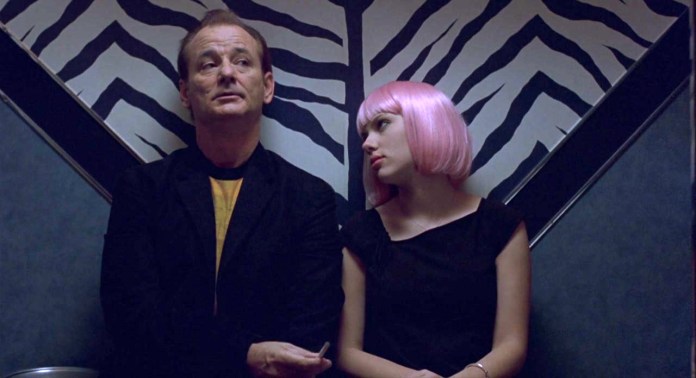
Murray plays Bob Harris, a middle-aged actor who travels to Tokyo to endorse Suntory Whiskey by shooting a commercial. “For relaxing times, make it Suntory time,” he tells the camera before being interjected by the Japanese-speaking director. The director goes off on this rant towards Harris on what to do and how to read the lines, yet the translator simply tells Bob, “…more intensity.” His marriage to his wife seems to have developed a boring pattern where he almost feels like he doesn’t want to go back home during some scenes. ScarJo plays Charlotte, a beautiful young woman with a husky voice who is unhappily married to her photographer husband. She accompanies him on an assignment in Tokyo where the Japanese signs and the jet lag leave her in a state of disorientation. Before they meet each other, we see that Bob and Charlotte are both lost. Lost in the language. Lost in the culture. Lost in their respective marriages. These two characters have so much in common that we almost expect them to have sex once they meet each other, yet they never do. Coppola is aware that these two are mature grown-ups and, with her heartfelt screenplay displaying raw feelings, she is able to bring them closer to each other more than sex ever would.

Bill Murray is sarcastic, funny, and heartwarming in a role that was meant for him. He portrays a man who is sometimes sad, but sometimes happy—especially when he’s with Charlotte or discussing children. “And they turn out to be the most delightful people you will ever meet in your life,” Murray ponders as he’s lying in bed peering at the ceiling while discussing with Charlotte the prospect of having kids. Scarlett Johansson is subtle yet powerful. She exudes this obvious affection for Bob with hypnotic glances or heart-to-heart conversations, ones that seem like she’s never had with her own husband. Not to be outdone, the supporting actors do an amazing job as well. Giovanni Ribisi plays the unlikable husband, someone who’s too caught up in his own ambitions to pay any real attention to Charlotte. But my favorite supporting role goes to Anna Faris’ portrayal of Kelly, an actress who comes to Tokyo to promote her new action film and ends up flirting with Ribisi’s character. No one plays a ditzy character better than Faris, even though she is in maybe 3 or 4 scenes.

The effortless chemistry between Murray and Johansson is on full display when they aimlessly delve into the city—attending places like karaoke parties or go-go bars. They wander through Tokyo like it’s Mars, and that’s what Sofia Coppola is trying to convey. This film is her version of a love letter to Japan, emphasizing its weirdness and quirkiness throughout the 100 minutes.

I’ve said this to my friends plenty of times and I’ll say it again—this is one of my all-time favorite movies. There’s not one genre that Lost in Translation appropriately falls under because it displays several of them. I appreciate how Coppola doesn’t let the film become too much of a formulaic rom-com, a genre that is far too familiar in the film industry. Instead, she uses the characters’ blatant honesty as well as the talent of the actors to portray a sentimental relationship that makes the lives of the two characters a little better and more promising.

In perhaps the most important and genuine scene of the movie, Bob is leaving for the airport when he sees Charlotte walking down a crowded walkway. He gets out of the car and runs to her and they share a hug before Bob whispers something ambiguous into Charlotte’s ear. With the camera angles focused on each character’s face, we can tell that it’s something meaningful and it rightfully is because Coppola never discloses what he whispers into her ear. It’s something sacred that should be kept between them because they deserve their solitude. Right before he leaves, he gives her a kiss goodbye and hugs her one last time. As they depart, Just Like Honey by the Jesus and Mary Chain begins to fill the background noise as we sense that the lives of these two characters resume back to their original lifestyles. And it’s this feeling that I touched upon in the beginning of the post when you’re leaving for the airport that everything starts to crumble back to reality. Honey conveys this melancholy feeling perfectly and Coppola ends it on a somber yet beautiful note.

CONSENSUS: 4 out of 4 bottles of Suntory

Standard