
SPOILERS!
Every now and then, a film comes along that dares us to do the unthinkable: to think. A movie normally lays out its premise for the audience and allows the story to unfold before the final scene ties everything together or leaves off with a cliffhanger (Halloween and Friday the 13th film franchises, I’m looking at you). But Darren Aronofsky, a renowned filmmaker with plenty of credibility in the industry, completely flips the script on what a movie can be. He uses his heart-wrenching and feverish concerns for our world to create a metaphorical piece that disguises itself as a psychological horror film. Entitled mother!, the movie initially has a simple premise where it seems like we’re witnessing a conventional home invasion thriller. But it’s more than that—IT IS SO MUCH MORE THAN THAT. To put it mildly, the film is essentially an exercise in mind-fuckery, an “assault of the senses” that left me weak in the knees as I left the theater. Not since I saw Inception at the movies has a film made such an impact on my thoughts. But unlike Inception, mother! forced me to reflect on humanity and how we are contributing to our own demise. At the center, the film is about the natural characteristic of human greed; Aronofsky illustrates this theme using biblical allegories, specifically events from the Old Testament and the New Testament.
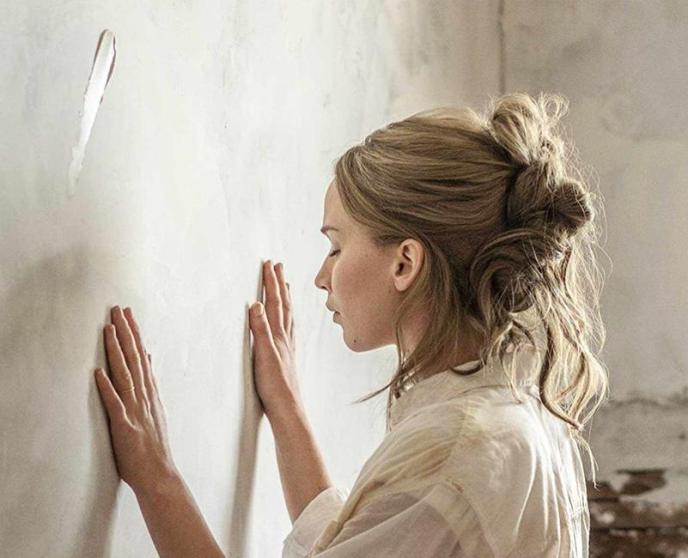
At first glance, mother! has a non-convoluted setup: an attractive couple are living peacefully in a grand old house in the middle of nowhere until an uninvited older couple shows up and then things go awry. Simple, right? False. Because no character in the film has a direct name and everyone refers to each other using pronouns, we are free to interpret what each character represents. Jennifer Lawrence is meant to embody mother Earth, hence the title of the film. She is physically connected to the house (the house represents the world) as she walks around barefoot—a conscious choice made by Lawrence to emphasize her purity—and is able to envision the house’s literal beating heart every time she places her hands onto the walls in a meditative manner. Javier Bardem, meanwhile, is meant to play a form of God, a creator/author who gave rise to everything we see in the film, but also is suffering from writer’s block and trying to create his next masterpiece. They are alone in this big house, and we get a sense of their isolation thanks to director of photography Mathew Libatique’s beautiful cinematography, one where the camera follows the back of the characters to dizzying yet adventurous effect. We see this prominently right after Lawrence wakes up and wanders around the house; the sounds of Lawrence’s footsteps combined with the creaking floorboards and the breeze billowing outside the walls create this peaceful yet lonely atmosphere.
The couple’s serene isolation is interrupted when there’s a knock at the door one quiet night. Remember, Bardem embodies the God/Creator figure. Therefore, notice how right before we hear a knock at the door, something clicks in Bardem’s mind and he quickly writes down his thoughts; whatever he is creating on that piece of paper is brought to life as man, played by Ed Harris, walks through the door. A self-proclaimed fan of Bardem’s “work”, man (or Adam) is drawn to a crystal that’s placed on a pedestal during the first minute of the film. His wife (or Eve), played by Michelle Pfeiffer, appropriately arrives after we witness the scar on Adam’s rib the night before (the Book of Genesis states that God took Adam’s rib and made out of it a woman, Eve). She too is drawn to the crystal on the pedestal. By now, it’s clear that the crystal resembles the “forbidden fruit” that hangs from the Tree of Knowledge. While Bardem continues to plead with man and woman to not touch it, they ultimately disobey and unsurprisingly shatter it into bits and pieces, infuriating the Creator and making Him banish man and woman from the “garden.”
Adam and Eve’s two children (Cain and Abel) then barge into the house incessantly arguing. Their back-and-forth bickering culminates in Cain killing his brother. Arronofsky reenacts the original sin to showcase the blatant truth about humanity. As beautiful as mother makes the world out to be by tending to the house and making sure its resources are plentiful, it is ultimately a place not meant for coexistence amongst humans as evident from murder occurring within family, something that’s built on love. The state of the house is presented as mother again places her hands on the walls and observes its beating heart has deteriorated into a gray color. There’s also a bold blood stain on the wooden floor that mother can’t remove despite all of her efforts—it just remains stagnant, staring back at her. When man and woman decide to hold a vigil for their murdered son, unfamiliar faces start to make their way into the house, much to mother’s annoyance and confusion. The guests stop behaving like guests and begin to make themselves too comfortable, filling the house with corruption that’s ultimately cleansed by a sink pipe that’s burst open; this is meant to represent the Great Flood as it expels all of the humans out of the house, or the world. This concludes the first half of the film, or the Old Testament.
After man and woman and their guests are vanquished from the house, the calmness and relief is slowly stored back into mother’s gaze. At this point in the film, mother resembles the character of the Virgin Mary. As soon as the words “I’m pregnant” are muttered by mother the following morning, we are able to predict Aronofsky’s intention in retelling the effects of the life and death of Jesus, aka the New Testament. The Creator, upon hearing the news, instantly jumps out of bed and writes down his brand new masterpiece. For the first time in the film, we see the Creator cherishing mother the same way she has been cherishing Him throughout the movie, which probably hints at an insight into their relationship: mother truly loves her husband and is willing to do anything to keep him happy, but the Creator only seems to pay any mind to His wife’s unwavering love when she advances and fuels his mentality to write something that will propel his notoriety—this is an important detail that helps shape the ending.
Some time passes by and mother is preparing to give birth when the Creator’s finished work is published. To celebrate this achievement, mother prepares a celebratory dinner for just her and her husband. Receiving word of His book selling out, the Creator temporarily abandons His wife and greets a mob of fans that have surrounded the house, asking for autographs and revering His simple presence. Back inside, mother barricades herself as fans start to casually let themselves in. The shaky camerawork that follows Lawrence creates relentless fear that’s characterized by crippling anxiety as she spins around the house finding a plethora of foreign faces. From the perspective of a woman pregnant with her first child, this is terrifying to witness. As more and more people swarm into the house like bees, the scene descends into chaos as every human takes objects for keepsakes and corrupts the environment that mother has devoted her time to in perfecting. Different people coming in means different perspectives too, which obviously leads to violence. What was once a vessel of serenity and beauty in the beginning of the film has now turned into a war zone. Mother helplessly navigates herself through rooms we can’t even identify anymore because of the damage that the humans inflicted upon the house.
Mother then goes into labor and the Creator guides her to a private room that is surprisingly left intact. She is able to give birth with thousands of the Creator’s followers hovering around the room. Wishing to stroke his own ego, the Creator takes the baby from sleeping mother and presents him to the crowd, despite mother’s incessant pleas not to. What transpires is a horrifyingly graphic sequence not meant for the fate of heart; this scene alone is the reason why pregnant women should stay away from mother! The baby is seen being carried by the sea of people, who then inadvertently snap his neck, which alludes to the crucifixion. Jennifer Lawrence’s reaction in this sequence is so raw that she started hyperventilating, cracking a rib in the process. When she comes across her baby’s mutilated body, her reaction is that of pure terror—her pain and mortification is so palpable through the screen that it’s a shame the Golden Globes overlooked her performance.
Catapulted into a fit of rage, mother’s broken heart appropriately causes the floorboards to break apart as she makes her way down to the cellar. Ignoring her husband’s pleas, mother sets fire to the oil tank and destroys everything entrapped in the Garden of Eden, including the people, the house, and the plant life outside. The Creator, however, is left unharmed and carries mother’s badly burned body. When she tells Him in a gut-wrenching voice that she has nothing left to give, the Creator asks for her love and He physically pulls out her heart from her chest. As mother turns to ashes—her heart was what kept filled her with life—the object in the Creator’s hands breaks down like coal and the crystal object is revealed again. Like the first minute of the film, the Creator places the crystal on the pedestal and the whole setting is once again renovated, but this time, a new mother fills Lawrence’s shoes. After catching a glimpse of her face, the screen cuts to black as we sit there pondering about the cyclical narrative this movie just touched base upon. The only song in the movie, Patti Smith’s cover of The End of the World, begins to play and hauntingly ties up everything we just witnessed.
The way that Darren Aronofsky presents this movie is a testament to the human nature of compassion and comprehension. He creates this allegorical piece where mother Earth is a living and breathing woman, played by a vibrant, young Jennifer Lawrence. It’s the only way that we humans can understand how we are mistreating Earth through our wars and our self-absorbed tendencies to consume. Because mother earth is human in this film, it’s easier for us to express empathy and sorrow for her because we see the physical abuse/trauma she endures and the strangers that walk all over her—the emotions are there and Jennifer Lawrence brings humanistic qualities to something that arbitrarily surrounds and supports us. Aronofsky is scorning us for being so unrelenting to our home. We see how mother gives and gives throughout the film with the use of mobile limbs and affection expressed through her visible face. But because mother Earth isn’t actually this divine human being and instead the “water” that surrounds us, we take her for granted by polluting her airways, destroying her natural creations, and creating conflicts that lead to bloody war.
Regarding the cyclical nature of this story, I think it’s important to comment on the meaning behind the crystal that originates from within mother’s heart. You see, we are lead to believe that God is solely responsible for everything we see in the film—from mother to the setting to humanity, etc. However, he is unable to recreate these in the first place without mother’s love. Referencing Shel Silverstein’s The Giving Tree, Aronofsky states that mother’s love and support is omnipresent—always giving—and is represented by the crystal that is placed on the pedestal. Without a foundation to build life on, God is powerless without mother and requires her heart to catalyze a new creation cycle. When a new mother awakens in the bed in the final shot of this film, this is meant to signify the dawn of a new creation cycle, one where Earth continues on after the period of humanity. While it’s hard to imagine an Earth existing without humans in the far future, all it takes is a review of the prehistoric era—and how giant reptiles were completely decimated by a meteor—to comprehend how Earth is able to replicate new life in different manners. As Aronofsky points out, “It won’t be our story anymore.”
Darren Aronofsky is able to use his creative panache to tell a cautionary tale about humanity by applying conventions that make for a heart-racing and terrifying ride. He illustrates this disturbing reality using intricate camera work that perfectly captures the perspective of an innocent wife and mother. There’s a lot of pressure on Lawrence’s shoulders throughout the film and she handles it extremely well as she expresses emotions ranging from cheerful bliss to sheer terror. Michelle Pfeiffer, who plays the metaphorical Eve in the first half, steals the show when she amps up the enticing behavior of Eve.
The allegory presented in this film is no code that requires several viewings in order to unlock the meaning behind it. However, it’s an interpretation that forces the viewers to evaluate themselves and their tendencies of self-righteousness. Mother! pinpoints the absurd manner in which we live our lives—worshipping false idols, claiming whatever we want as ours, creating war—and cautions us that this trend is bound to cause our demise. This film will not sit well with everybody and it shouldn’t, but man, hats off to Darren Aronofsky for conjuring up something that does everything it’s meant to do by making us think and converse.
CONSENSUS: 3.5 out of 4 murderous Kristen Wiigs

