

©Magnolia Pictures
SPOILERS!
I remember being 4 or 5 years old when my dad somehow told me that people grow old and die. Because I was so young, I was completely overwhelmed with this revelation; You mean to tell me that someday, I will no longer be here? is a question that kept swirling around my head. It was a brisk wintry afternoon with gray skies and while my dad was doing yard work on the front lawn, I walked over to the edge of the sidewalk and stared onto the gravel in front of me. I started crying as this new concept of death left me bewildered and longing for immortality. It’s weird how something so inevitable could affect your mindset and how you go about your days. Well, this theme is explored fervently in Lars von Trier’s meditative and existential art film, Melancholia. In the movie, we see a rogue planet appropriately called Melancholia approaching Earth, indicating the apocalypse; as the end of the world nears, we observe how two sisters “prepare” emotionally for their demise.
 Pieter Bruegel the Elder, Hunters in the Snow (Winter), 1565, oil on wood, 162 x 117 cm.
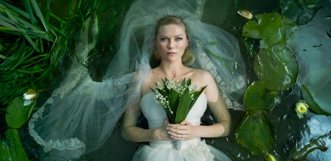
Before anyone utters a line of dialogue, Melancholia begins with the ending. In the course of its first 8 minutes, von Trier assembles a montage of images that seem ambiguous under first viewing. There’s a close-up of Justine (Kirsten Dunst) as she slowly opens her eyes while dead birds fall out of the sky behind her, foreshadowing the disaster that’s on its way. There’s a shot of Pieter Bruegel the Elder’s Hunters in the Snow, a Renaissance painting that evokes a sense of hopelessness—a group of hunters is seen trudging through the snow with their heads hanging, towards an ice skating rink littered with upbeat peasants. There’s a serene image of Justine floating down a narrow stream, donning her wedding dress and veil; this shot eludes to John Everett Millais’s Ophelia which depicts the character from Hamlet as the burdens of her grief lead to her deliberate drowning. This picture also heightens the depressive mood that Ophelia was in as the water envelopes Justine’s dress, ultimately weighing her down into the abyss. As we move from shot to shot, Richard Wagner’s prelude to Tristan and Isolde accompanies these crisp and detailed images. This romantic composition adds to the beauty of the montage, and yet, the piece’s strings give the sequence a tragic atmosphere, which appropriately goes hand in hand with the final shot being the collision between the two planets. At this point, we understand that the montage’s purpose was to serve a condensed version of the narrative.
I believe that Lars von Trier is not particularly concerned with the ending. With mainstream apocalyptic films, the audience’s main concern is whether or not the protagonists will survive or if the apocalypse will/won’t occur. Instead, von Trier uses the apocalypse as the set up. Because we know the ending to the film, we want to know how we get there and how the preceding images symbolically reflect the narrative.
The first half of the film, entitled “Justine”, details the younger sister’s gradual descent into depression in the midst of her wedding reception. A staple in Lars von Trier’s films, the editing style of cutting to a scene that marks the end of something is very prevalent in this half. A clear example is the fact that von Trier starts off his narrative not with the wedding ceremony, but at the wedding reception in the peak of night. As a result, the audience feels a bit detached from what’s going on, just like the way Justine feels as the night goes on. Characters sprinkle hints here and there about Justine’s condition. Her sister, Claire (Charlotte Gainsbourg), confronts her and pleads with her to “not make any scenes tonight” and Claire’s husband (Kiefer Sutherland) commands Justine to “be happy.” As the reception progresses, Justine delves deeper and deeper into her manically depressive episodes. When she tries to revive herself or when others urge her to snap out of it, Justine returns to the continuing party, but as her episodes become more and more frequent, her condition follows her out into the party. In the beginning she was able to repress her condition, but like Ophelia, her depression begins to swallow her and drag her down until we barely recognize the bubbly new bride that comically tried to get the limousine through the narrow country road in the beginning of the film. The disease takes such a firm grasp on Justine that her new husband, Michael (Alexander Skarsgard), calls off their wedding, and she is fired from her job at the first half’s conclusion.
If the first half of the film was a preview of Justine’s state of mind, the second half serves as the main attraction. Although entitled “Claire”, this second half is more concerned with the approach of planet Melancholia, and how this event plays a role within the minds of both sisters; how will Justine’s depression stack up against the most depressing situation and what role will this impending doom play in Claire’s existential anxiety? Because we are so focused on Justine and the wedding reception during the first half, we gloss over a fairly interesting detail about Claire—she is always the one to act according to plan. We see her distraught over Justine and Michael’s late arrival to the wedding reception, unamused as she tries to console Justine and prevent her from causing a scene, and very casual when she tosses her sister’s bouquet for her. Based on these actions, Claire always makes sure everything runs smoothly. So when her sister becomes detached from her world, it is up to Claire to revive her at the start of the second half. From drawing a bath for her to cooking her favorite dish, Claire does everything in her power to get things back to normal. But when something inevitable and out of her control starts to happen like the world ending, we see Claire crack for the first time; she becomes inconsolable because death by apocalypse was never in her blueprint.
In the beginning of the film’s second half, we see how Justine’s mental illness takes a toll on her. She doesn’t get out of bed because her limbs, once mobile and light, are too heavy to help herself into the bath tub. Her sense of taste has vanished—meat loaf, her favorite dish, “tastes like ashes.” Stylistically, von Trier is able to convey this sense of detachment by using slow motion images during the 8-minute introduction. An image shows Justine in her wedding dress trying to escape a forest with weeds tied around her ankles. These pesky tendrils represent the effects of Justine’s depression as her sense of self is taken away from her–time basically stands still. To me, this movie is one of the most genuine portrayals of depression ever. Mental illnesses are generally stigmatized and it’s due in part to our very little comprehension of them; even science has yet to establish any significant findings. This rift between science and reality is perfectly illustrated through the notion of Claire’s husband constantly reassuring her that Melancholia’s trajectory will avoid Earth’s orbit, but all of his scientific data proves to be inadequate as the rogue planet circles back and heads for Earth. This is meant to perhaps show that not even science can provide us with concrete answers, just like how it can’t provide us with answers when it comes to something that’s as prevalent in human existence as depression.
By the end of the film, we witness the emergence of Justine from the depths of her illness. As Lars von Trier points out in an interview, this move is a nod to how depressed people tend to remain calm during catastrophic events. The end of the world doesn’t seem to have an impact on Justine’s psyche. Emotionally, she is so far down into the barrel of despair, that a major event like the apocalypse serves as a bolt of enlightenment for Justine as she confronts Claire about how the end of the world isn’t something to sweat or cry about because “life on Earth is evil.” On the other hand, Claire responds with disbelief to Justine’s nihilistic viewpoints and as a result, she becomes a lot more hysterical and starts to panic in the face of death. The roles have swapped and Justine transforms into the more rational and “saner” sister at the film’s conclusion.
Claire’s uncontrollable hysteria reminds me of that anecdote that I referenced in the beginning. You live your life planning out the days in your future, all of the things you wish to accomplish, and then abruptly, you’re informed that your days are limited—that death ultimately awaits you. Claire does not wish to die, for she has all the amenities one could wish for: a healthy marriage and an affluent lifestyle. But Justine’s nihilism pushes her away from a great job or domesticity because she realizes human life is so small and insignificant when it comes to the entire scope of the universe—it’s absurd to become frantic or to dwell on the fact that the world is ending because, as she points out, “life is only on Earth, and not for long.” That’s why her depression transforms seamlessly into a state of serenity.
 ©Magnolia Pictures ©Mosfilm
I’d be remised if I didn’t briefly talk about the inspiration behind some of the artistic references in the film. With von Trier’s incorporation of Bruegel’s painting and Wagner’s prelude, it’s pretty obvious that Andrei Tarkovsky’s Solaris plays a big influence on Melancholia. Besides sharing the themes of human existence, both films make significant use of Bruegel’s painting, Hunters in the Snow; the painting’s appearance in Solaris comes at a climactic moment when Hari, the carbon copy of Kris’s dead wife, comes to a realization that memories of the past are what makes humans truly human. Von Trier’s use of Wagner’s prelude is clearly influenced by Tarkovsky’s incorporation of Johann Sebastian Bach’s chorale prelude in F minor, Ich ruf’ zu dir, Herr Jesu Christ, BWV 639. This method of using music as a refrain is a way for the filmmakers to inform the audience of not only how they should feel but that they’re about to enter a contemplative world that’s specifically its own. There’s also the poster of Melancholia that’s taken from the Ophelia-inspired image. But if you look at the edges, Justine’s elegant white wedding dress is surrounded by a serene stream of water with vibrant greens. The first shot of Solaris is the infamous dream-like image of bright green weeds dancing beneath the surface of a body of water—the weeds representing memories from the past that continually define who Kris is in the present. By using the greens in Melancholia, von Trier points out the memories that Justine detaches herself from when she slips into her depressive coma.
For sure, Melancholia is a controversial film. After all, Lars von Trier has never been afraid to push the boundaries of cinematic filmmaking. At times, the film’s pace may seem a bit too glacial, but that’s in part due to von Trier’s signature documentary-style filmmaking; it’s a rule that he has conformed to ever since creating the Dogme movement and it helps create a sense of realism for the viewers. Kirsten Dunst is absolutely mesmerizing and devastatingly haunting in this movie about a disease that distorts the person’s relationship with the surrounding world. Melancholia is such an unconventional film because there’s never been a film so earnest about depression before. The disease is still not fully understood even today, and the film clearly points to that, by correlating it with the apocalypse in a poetic and almost fairy-tale manner. Justine, for instance, knows how many beans are in the bottle at the reception because “she knows things,” which means she possesses some truth when she states that life on Earth is unnecessary. Her nihilistic personality is reflected in the final shot when Melancholia collides into Earth. Before Justine is swallowed up by the collision, we see her silhouette sitting upright and almost unaffected by the inevitable doom—she looks like a deity that commands one’s attention. Through artistic expression like Lars von Trier’s Melancholia, depression is presented under a spotlight as its ambiguity opens up a conversation that follows viewers long after the credits roll.
CONSENSUS: 4 out of 4 beans in the bottle
 Suntory Times