
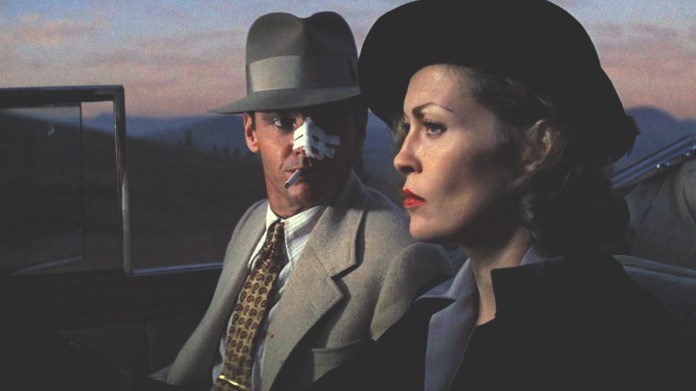
©Paramount Pictures
SPOILERS!
You may be wondering why I’m reviewing two Polanski films in a row, or you may not care at all and instead be wondering why I’m wondering about a nerdy statistic. Anyway, the reason behind this scandalous decision is that I came across this film in the midst of my spring semester when me and other students were assigned to watch the movie for film class. The film is called Chinatown and it marks the last Polanski feature film that was manufactured in America before the Polish director fled to Europe following charges of sex with an underage girl.
Like other Polanski films, Chinatown contains a premise that seems simple at first glance, but contains elements beneath the surface that cause viewers and filmmakers alike to revere this neo-noir classic to this day. From the old-school opening credits to the renowned last line, Chinatown is a crime drama that pays homage to the noir mysteries of old Hollywood, but leaves an imprint on the viewer’s mind that’s impressively the film’s very own.
Today, Chinatown is known for its star power and a screenplay that will forever be studied in film schools. Jack Nicholson—before he was McMurphy, Jack Torrance, the Joker, or any other stereotypical caricature of himself— was J.J. Gittes, a private investigator with a sliver of sadness in his eyes. Everything he does is filled with purpose and the efforts that he goes through to satisfy other people’s needs makes the ending that more tragic. Normally, we expect a sidekick in these types of sleuth films but the isolation of Gittes is perfectly executed through the indifferent gaze that Nicholson provides. The reason why Nicholson is such a beloved American actor is not because of the erratic characters we’re so used to him playing, but because of the subtler performances that round out his filmography.
The plot follows the genre tropes of the classic noir mysteries during the era of the Bogarts and the Hayworths: the private investigator encounters an intriguing woman, has a fling with her, but then she turns out to be someone she isn’t, and the hero has to deal with the conflict of dangerous love vs. moral justice. However, in good ol’ Polanski fashion, this is just the tip of the iceberg. Initially asked by an elderly woman named Evelyn Mulwray to spy on her husband for an infidelity case, Gittes is then visited by the real Mrs. Mulwray, played by Faye Dunaway (today’s youth might recognize her by Best Picture is…La La Land). Her husband is found murdered and Gittes deduces that Mr. Mulwray, who was the chief engineer for the LA Department of Water and Power, discovered a plot where the water department was deliberately drying up the land so that the water could be bought at a reduced price.
Gittes finds out that Mulwray’s former business partner was Evelyn’s father, Noah Cross (coincidentally played by iconic noir filmmaker John Huston). Cross hints at Gittes to not get involved with the situation unfolding as a result of Mulwray’s washed-up body. There’s obviously something fishy taking place once Evelyn starts to plead with Gittes to stay away from her father—her body tenses up and her voice stutters at the mention of her father’s name. it isn’t until after Gittes and Evelyn sleep together that we find out who exactly Noah Cross is, which gives the audience the green light to label him as the film’s antagonist.
And just as soon as we attain a grasp on who’s who and what’s what, Chinatown ends swiftly with a final scene that eerily comes full circle. Robert Towne’s original screenplay called for an upbeat ending where the protagonists prevailed while the antagonist was killed off. With Polanski’s pregnant wife being murdered by the Manson family 5 years prior to the release of this film, this ending just didn’t seem plausible. Therefore, Polanski revised the ending to a bleaker and grim finale—one that doesn’t really give the viewers any closure, a characteristic that the director has explored to perfection previously in films like Repulsion and Rosemary’s Baby.
What I love about this film so much are all of the Easter eggs that viewers pick up on in subsequent viewings. It’s something that I shed light on in the previous review on Rosemary’s Baby. There’s something admirable about a movie that has its filmmakers lay out puzzle pieces for us so patiently and a bit casually, and then tie them together with an abrupt conclusion. That’s why, 44 years later, Chinatown is respected as one of the most significant cinematic achievements. A big example is the character of Evelyn Mulwray. Initially cold and intimidating, Evelyn soon transforms into someone we root for once we realize her situation. But as soon as we seem to wrap our head around Evelyn, she is killed in a violent manner in the film’s memorable final minutes. Watching the film again, however, we pick up on things that foreshadow things to come. Just before their love scene, Gittes points out a fault in Evelyn’s left iris—a sort of birth mark; coincidentally, this is exactly where Evelyn is shot, killing her. After the pair make love, Gittes confronts Evelyn in her car about his suspicions about her. An exasperated Evelyn leans on her steering wheel for support, and is greeted with a honk that pulls her back. Evelyn’s death is later identified by the sound of a horn blaring from her car; we then find her lifeless body leaning on the steering wheel. Another minute detail is placing a melted ice cream cone next to a dead body, indicating the time of reference for the crime.
Despite its status as a classic film with a screenplay that’s used as a model for aspiring screenwriters, there’s still a cloud of mystery that hangs over Chinatown. To me, this cloud is attributed to the interpretation of its title because it’s only in the last five minutes that the film takes place in the aforementioned location. So, why exactly Chinatown? Well, for starters, Chinatown is exactly where the most palpable scene of the movie takes place—Evelyn is gunned down in a disturbing image, the bad guy prevails, and the film’s most epic line of dialogue is delivered with the gleaming lights of the location in the background. Despite its very brief appearance in the movie, Chinatown is an omnipresent force within the main character’s psyche. In the beginning of the movie, Jack Gittes is a very nonchalant hero, patronizing to whoever walks into his office and using his dry humor to get on a person’s good side. He reaches premature conclusions about his clients because his past haunts him; the last time he got too emotionally invested in a case, his client was killed…at the same location. Therefore, the location of Chinatown almost serves as a lingering metaphor for failure on Gittes’ part to protect the ones that deserved justice. “Forget it, Jake; it’s Chinatown” is almost like a cruel reminder to Gittes that he, yet again, inadverdently allowed the bad guys to win. Despite the encouraging tone that the line is delivered in, one gets the sense that this will further catalyze Gittes’ repression of his concept of Chinatown; he definitely will not “forget it” and instead become even more indifferent than he previously was.
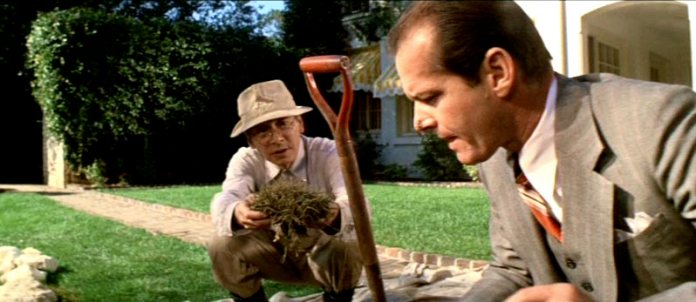
Chinatown, like its residents, also represents the detachment people have from those who possess full power. Noah Cross is a powerful figure and is able to manipulate the people around him to prevail. In a case of dramatic irony, we know what type of conniving man Cross is, but the authorities turn a blind eye to his moral crimes—this is evident in Evelyn’s line as she is trying to escape Cross’s grasp: “He owns the police!” Despite Gittes’ good intentions, his powerlessness contributes to the ill-fated ending. Much like the crowd of Asian locals that surround the crime scene, Gittes serves as a bystander to this horrific crime and has no other choice but to emotionally detach himself from the situation at hand. And this is the same attitude that the movie serves to the racial Other. The movie comes under fire in today’s time because of its racist portrayals of foreigners. The film seemingly makes fun of Asian immigrants and brings up racist stereotypes. However, beneath this first glance, there’s actually a subtle message that Polanski perhaps wishes his viewers to linger on. The movie’s racism isn’t so much of a purposeful reflection of the times of filmmaking, but instead, could be looked at as a deliberate way that we as a society observe foreigners. Behind the stereotypes that blind us, there are human beings and Polanski does this by showcasing shifts in narrative when we come across a Hispanic boy or a Japanese gardener. The Mexican boy on the horse approaches Gittes to inform him of the reason behind the drought in the LA water ways. And the most significant example is the Japanese gardener pointing out that the salt water is “bad for gl/rass”, identifying the bifocals in the koi pond and thus pinning Cross as the murderer of Mr. Mulwray (Cross is the only character that wears bifocals). Despite these people being such integral parts to the narrative, they are always sidelined and excluded from American society; this is reflected in the last shot when Gittes walks away and into the crowd of staring, bewildered Asian residents.
And with that ending shot, we encounter a recurring theme in a lot of Polanski films: there’s never a happy ending or clear resolution because life is rarely synonymous with clarity. Despite the audience’s urge for the heroes to prevail, Polanski offers a sobering tale about evil coming out as the victor—rainbows and butterflies are not reality (Polanski would be the first to tell us that). Chinatown not only succeeds in conveying this message, but also offers a mirror to the white majority, and our prejudiced tendencies to sideline those who contrast from us solely on a physical level. Because at the end of the day, we need each other for survival—we need each other to move narratives.
CONSENSUS: 3.5 out of 4 nosy, fellow kitty cats

