
SPOILERS!
The Beguiled opens with a beautiful shot of a spacious forest. As the camera pans in and around the area, the viewer is allowed to get settled in and transported to a different time period. Not an uncommon trademark for the director, long and drawn-out shots are aspects that Sofia Coppola incorporates into her films in order to help familiarize the audience with the film’s setting. With zero music, the title of the film is presented in outlandish pink letters in the middle of the forest—reminiscent of old-school Hollywood opening credits. As Coppola takes her time in offering the forest to our eyes, a young girl with braided hair appears as she walks along the way and picks up mushrooms. Throughout this, we mainly see the back of her while our ears are filled with the background noise of birds chirping, trees billowing in the breeze, and weapons firing in the distance amidst the Civil War. Not being able to identify the young girl in frame combined with the foreign sounds in the background make for an eerie sequence that only further captivates our attention. While picking for mushrooms, the girl—named Amy (Oona Laurence)—encounters a badly wounded Union soldier, Corporal John McBurney (Colin Farrell). After some initial hesitation from Amy, she helps McBurney up as he leans onto his innocent companion and hops his way onto Martha Farnsworth’s girls school, led by the stern and strong-willed Ms. Farnsworth herself (Nicole Kidman).
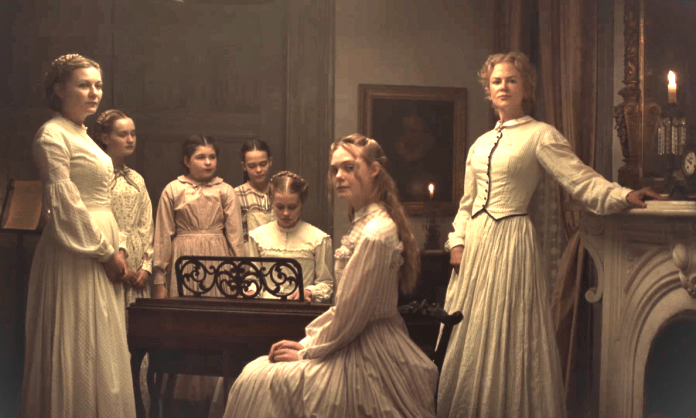
Before McBurney arrives at the school, Coppola shows us what life is like within the confinements of this institution. Some of the girls are tending to the gardens, while the others are reciting words in French back to Edwina Morrow (Kirsten Dunst), a teacher in Ms. Farnsworth’s school with eyes that seem to long for something outside the walls. Alicia (Elle Fanning), one of the older teenage girls with palpable hormones, is the only one that seems to know what she wants yet is aware that she can’t attain it. And yet, her prayers are answered when McBurney stumbles onto the doorstep unconscious, simultaneously sweeping the air out of the surrounding space and thus sending Alicia’s hormones through the roof. I love the way Coppola so clearly shows the effect of McBurney’s arrival. His abrupt presence decimates the monotony that seems to be swirling within the school for quite some time. For four years, these women have been so isolated and so cooped up in their daily routines that they’re practically revived by the arrival of not only a new guest, but a seemingly vulnerable male soldier. The women have more intent in their voices as they discuss what to do with McBurney’s unconscious body. Alicia’s bored expression is transformed into an attentive one as she continuously glares at this vessel of masculinity lying on the porch. The younger girls stare on with fascination, while the older women—Martha and Edwina—slowly but surely become attached to McBurney. Sofia Coppola is able to progressively build up the sexual tension throughout the course of this film. In one of the first instances, Martha sponges McBurney’s wounded body. A scene that required two hours to film, Coppola uses the natural afternoon sunlight to emphasize McBurney’s masculine body and to help awaken Martha’s suppressed sexuality. Martha quickly brushes off these urges and focuses on the task at hand. However, the inevitable takes places as all of the women in the house begin to vie for the soldier’s affection.
The younger girls begin to huddle by the door, while Martha and Edwina engage in romantic talks with the soldier. Not only is he able to win the women over with his good looks and charm, but the Corporal uses empathy as well to connect with them on an emotional level. Someone who’s in serious need of care, McBurney turns the tables on Edwina by asking her about the one thing she desperately wants in her world. As Edwina drifts into a monologue about her desire to leave the school and start her life anew, McBurney listens intently and lends his sympathy towards her in a romantic manner; he holds her hand and hypnotizes her affection with piercing eyes. As the women of the house begin to yearn for the corporal’s attention, they create a humorous situation in which they all begin to decorate themselves with extravagant accessories or colorful dresses that accentuate their femininity. There’s a hilarious scene in which everyone is sitting at the dinner table and each of the women begin to claim ownership over the apple pie that McBurney emphatically devours; Alicia points out that she made the pie, then Edwina cuts in and says it’s her recipe that Alicia followed, and then Amy highlights how she was the one who picked out the apples. These back and forth exclamations are fun to watch and the pettiness displayed onscreen between the actresses is ridiculously amusing.
While we find these initial scenes to be entertaining, it’s important to note that while each girl presents herself to the soldier in a flirtatious manner, the others take notice. Gradually, the audience becomes aware of the tensions that start to heighten due to the women’s apparent stern faces paired with jealous eyes. This tension ultimately culminates in a matter of a few seconds. Sofia Coppola takes a single shot of Alicia and McBurney fooling around in bed and pairs that with the audible gasp of a crushed Edwina who stumbles upon them. It is in this instance that Coppola showcases a drastic shift in the tone; in an instant, the movie jumps from the tone of a lighthearted yet intimate narrative to a thrilling and soap opera-like endeavor. Heartbroken and fooled by her discovery, Edwina throws herself into a fit of rage. As McBurney tries to console her, Edwina’s rage gets the best of her as she shoves him down a spiral staircase, damaging his injured leg for good. Up until this point, it seemed that the women were drifting apart from each other due to the growing emotional attachment each of them possessed over the Corporal. But Coppola is able to bring them back together and help emphasize that this isolated house in the midst of a civil war is a domain for female empowerment. The women of the house take drastic measures for they notice the extent of the damage to McBurney’s leg, ultimately amputating it while he is unconscious. When McBurney makes the vile discovery, he descends into hyperventilation and goes mad with fury, threatening the women with a gun.
Throughout the movie, I notice the control that McBurney subtly seeks over the women and Coppola brings that into the light through the theme of gender roles. Taking place in the 1860s, The Beguiled clearly establishes the role that men and women played back then; men played the soldiers, and women the homemakers. Men were authoritative and women were deemed the inferior sex. When weak and badly wounded Corporal McBurney arrives at Miss Farnsworth’s school, he mentally feels so small compared to the women; they are the ones in control of his fate and he serves no authority over them. Therefore, McBurney subconsciously resorts to methods of seduction over the women in order to garner his status of male dominance. Through the use of physical contact and deep soulful gazes, McBurney slowly ties a metaphorical leash around the group and becomes such an engulfing fixation in the women’s minds that they all turn their attentions towards pleasing him. Thus, the corporal is able to use his injury to his advantage by establishing his alpha male role within the household. And once he loses his leg, he goes on a rampage by waving his gun in the women’s faces, petrifying them as if his authority is hanging by a thread in the household. Because the women have taken away his leg, McBurney, at this point, is desperate to cling onto his manhood. While everyone is frightened out of their wits by his behavior, Edwina is the only one that doesn’t seem fazed as her libido continues to sizzle. She runs after him and they have passionate sex on the wooden floor in the guest room. After this, it seems that McBurney has yet again tightened his grip on the women in the house for he shows up at dinner later that night with a cheery disposition and Edwina’s arm locked in his grasp. Of course, the audience knows this is to be short-lived as a use of dramatic irony lets us know that the mushrooms the Corporal is about to eat were poisoned by Miss Farnsworth and her students. Much to Edwina’s heartbreaking dismay (she finally seems to have someone in her life that breaks the mundane cycle of the academy), McBurney collapses onto the floor as Farnsworth and the rest of the girls look on with no regret in their pupils. Despite the devastation in Miss Morrow’s eyes, she helps everyone else sew Corporal McBurney’s body into a shroud the next morning and stays behind with the women she’s known for the past four years.
The Beguiled has proven to be about a lot of things. Yes, it’s an intimate look into the repressed sex drive during a certain time period where men were off at war and women awaited some sort of resolution. And yes, it’s an interpretive look into the emphasis on gender roles and how some of the characters subconsciously mold them. But most importantly, it is also about the house where the entirety of this film takes place—the nifty details, the sun’s hues catching its borders, and the grand furniture that sets up the scenes beautifully. There’s an elegance in which the characters move throughout the house that I sometimes felt like I was watching a Broadway play. The house significantly highlights its female presence. “Established” gender roles don’t exist here and the women are able to prove, throughout their screen time, how powerful they are. When they stick together, they are extremely resourceful. They are willing to claw each other’s eyes out for McBurney, but yet that’s the thing, they all pursue something they lustfully desire—something that that time period’s society would heavily judge. And when they encounter a threat, they rely on each other to vanquish their unwanted guest. Like I’ve said before while watching other Sofia Coppola films, we see what she sees. The final shot is a testament to this, where all of the women sit on their front porch and look out into the distance after discarding McBurney’s body. The camera positions itself behind the gates that stand in front of the front porch steps. As the audience continues to look into the gaze of each woman, a sense of intimidation exudes through the screen for they hover around the house like lionesses defending their territory.
The Beguiled is not for everyone. Its pace might be slow and dragged out, but if you admire Sofia Coppola’s visual flair like I do, then you’ll certainly relish her meticulous shots. And if you have patience for those moments of uncanny silence, the film will prove to be a riveting tale of lust and human nature that’s truly highlighted by its masterly performances and grand cinematography.
CONSENSUS: 4 out of 4 horny Elle Fannings
 Suntory Times