

©Universal Pictures
SPOILERS!
We’re all familiar with the saying: “A picture is worth a thousand words.” It refers to the
notion that an image has limitless meanings, and is open to various interpretations by
different pairs of eyes. No other filmmaker’s body of work best fits this notion than the
films of David Lynch. Of course, this is no surprise considering the fact that Lynch was
trained as a painter at the Pennsylvania Academy of Fine Arts, where he was able to
hone his skills as a filmmaker after wanting to see his paintings move. His fixations on
dream and dreamlike imagery have influenced the way viewers watch his films, stirring
up conversations about these films’ plotlines years after they’ve been released. It
shouldn’t be a surprise that a painter has the ability to puzzle its audience, but when a
filmmaker does it, it completely defies the expectations of what a film should be; usually,
movies do the work for us by laying out X-Y-Z. What’s it about?…a question that
moviegoers are able to answer when leaving the theater. The answer then becomes
this elaborate talking point of what the plot is and how the characters drive the storyline
to a potential resolution. So many films have a tendency to spoon-feed us the narrative
that by the time we finish the film, we have a clear map formed in our head of what we
started with, what was thrown at us, and how we were able to overcome this
bombardment with the film’s ending.
Now, try asking that aforementioned question to someone who’s just finished watching
or has already watched David Lynch’s Mulholland Drive. For example, if one were to
ask me to explain the story of Mulholland Drive, I’d probably inhale, widen my eyes,
and purse my lips apart, but then I’d back track and gaze off into confusion because I’d
realize that I don’t really know what the the movie is about; there is no linear storyline,
characters initially come off as campy and two-dimensional, and the movie is presented
in dreamy vignettes that evoke the style of Pulp Fiction. However, now that I have time
to reflect and formulate my own thoughts, I guess the one word to truly describe
Mulholland Drive is control—specifically, a filmmaker’s control over his audience’s
emotions.
There is one particular scene that completely sets the tone for everything that follows
and as a result, it establishes Lynch’s intentions for us the viewers—and that’s the first
diner scene. At this point of the film, we are trying to attain any sort of grasp on the
film’s narrative. What we do know is that there’s been a car accident on Mulholland
Drive where a woman (Laura Harring), who we originally see with a gun pointed to her
head, escapes and sneaks her way into a stranger’s house. While this is happening,
Betty (Naomi Watts), who is an aspiring actress, lands in LAX with wide eyes and big
hopes, later arriving at her Aunt Ruth’s house—which is where the unknown woman is
hiding.
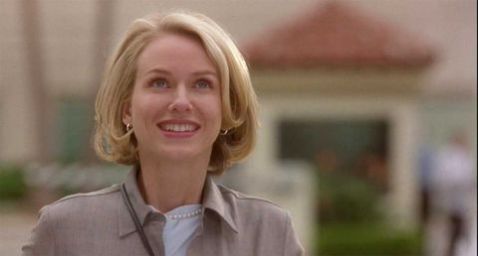
Lynch lays out the puzzle pieces with an air of ambiguity, and yet, he takes another left
turn by inserting a scene that doesn’t seem to belong in the narrative; it serves a
purpose in the film, but it doesn’t seem to serve a purpose for the characters we’ve
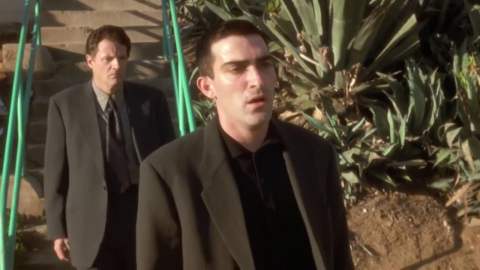
been introduced to so far. Two men sit across from each other at Winkie’s Diner. One of
them, Dan, is recounting a nightmare that he had about this very diner to his friend, Herb, and explaining to him that the only reason why he wanted to come here was to
“get rid of this god-awful feeling”—to conquer his fears in a way. In the dream, Dan and
Herb are seated in the same way and it’s still daylight, but they’re both frightened. Dan
realizes what it is and describes that there is a man behind the diner…“he’s the one
who’s doing it.” back to reality, Herb then gets up and heads to the counter to pay for
the check. The audience, along with an unsettled Dan, realizes that this image parallels
the one that Dan just described from his dream. Exiting the diner, Dan, with Herb
following his lead, is already profusely sweating, almost as if he’s nervous that what’s
transpiring in reality is in fact mimicking his nightmare. He reluctantly begins to
approach the wall in the parking lot, and with an uneasy camera tilting back and forth,
Lynch depicts a very dreamlike yet suspense-filled environment. He brilliantly details
that feeling of magnetic force we encounter in our nightmares when we are drawn to
approach our fears. He nears the wall, and before we’re even prepared, a terrifying
figure reveals itself as a sudden burst of noise catches us off-guard and Dan instantly
faints—thus, creating perhaps the most effective and horrifying jump scare in all of
cinematic history. It’s so scary that I can wholeheartedly say it puts all of James Wan’s
horror filmography to shame as it is able to execute a startling scare in broad daylight.
Mainstream audiences have grown accustomed to the night being synonymous with
terror, and when we witness such a shocking jump scare take place in daylight in what
looks like the middle of the city, it’s bound to prove some jarring results as it thrusts
viewers out of their comfort zones. Lynch also provides this scene because at face
value, it seems bizarre to include characters that aren’t woven into the rest of the
narrative; but yet, its randomness emphasizes the film’s themes revolving around
dreams—the scene itself is vital in trying to understand just what Lynch is getting at.
Of course, Lynch, an admirer and promoter of the unknown’s allure, proves this scene’s
worth the more the film progresses. With this jump scare, it doesn’t matter what our
expectations were when starting the film—Lynch fastens a leash around us by controlling how we react to what’s thrown at us onscreen, and in turn, controlling our viewing experience without us even knowing. Maybe that explains the confusion we feel when watching Mulholland Drive. We are confused because only one person seems to understand what’s going on in the movie and that’s Lynch the director; our brains are collectively trying to unlock the storyline. No matter how capable we seem to be at predicting what happens next, Lynch consistently halts the audience’s momentum by reminding us that we are always two steps behind him.
When Betty finishes her successful audition in front of the project’s director and
producer, the casting agent takes her across the lot into a film set, thinking her acting
chops would be better suited for a big-budget endeavor. At this moment, however, Betty
locks eyes with director Adam Kesher (Justin Theroux). Lynch knows this genre trope
and he knows we know, roping us in using technical conventions. He purposely utilizes
the editing style of two back-to-back close-up shots of each of the character’s faces as
they lock eyes with one another; this is the cinematic translation of romance or sparks
flying, and yet Lynch pulls the carpet from under us by never having these characters
really interact in the film again.
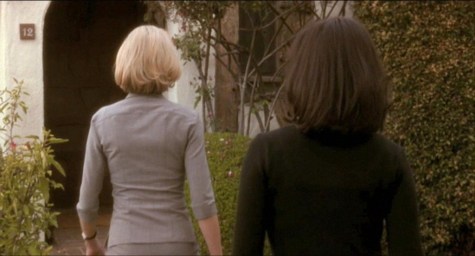
Another example is when the unidentified woman—who calls herself Rita—pairs up with Betty and decides to solve the mystery of her identity. They go to Winkie’s where Rita sees the name “Diane” on the waitress’s name tag and remembers the name, Diane
Selwyn. They find Diane Selwyn in the phone book (remember Yellow Pages?) but
there is no answer after Betty tries calling her. The women go to Diane Selwyn’s
apartment, and it’s during this sequence that Lynch’s genius is made apparent. Having
already witnessed a pretty traumatic jump scare, we begin to anticipate jump scares for
the rest of the film. Combining that with the unanswered phone call, Lynch utilizes long
and winding takes as characters cut through corners of their location and a subjective
framing that makes the audience members hold their breath as the camera follows the
female pair; we’re expecting something to jump out and terrorize our senses, and yet,
there is no additional jump scare. His Hitchcockian sense of suspense and his
continuous knack for toying with the audience truly creates tension that lingers
throughout the film and never loosens its grip.
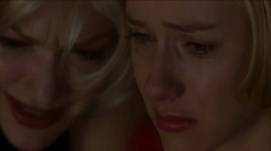
After they find Diane Selwyn’s corpse lying in bed, Betty and Rita attend Club Silencio
later that night. The club host announces to the audience that there is no live band.
Amid this confusion about what we’re supposed to see, out comes a female singer
(Rebekah del Rio) as she begins to sing a beautiful Spanish version of Roy Orbison’s
“Crying.” Again, Lynch controls our emotions and torments us even though we’ve
already been warned just moments earlier about the show being fake. He combines
close-ups of the singer’s passion when she belts out those notes with close-ups of Betty
and Rita weeping in their seats. Lynch purposely dictates how we’re supposed to feel,
but again, controls our responses by having the singer faint as we realize that she’s
been lip-syncing the entire time. We’ve been fooled by the movie again; it’s as if Lynch
shines the spotlight on his viewers as if to say, “Told you so.” Maybe this is Lynch
continuously reminding us that there is more than meets the eye.
Even when the movie ends with the last half hour depicting the real and more three-
dimensional Betty, we get the sense that Lynch will finally tie the narrative up by
somehow explaining the evolution of these characters in the final. However, we
continue to be at the mercy of Lynch who doesn’t let down his guard. Going into the
film, we are introduced to a story involving a spiraling mystery—instead of layers being
peeled off to reveal truths, layers are added on, and we leave the cinema under the
impression that the mystery continues to be a mystery. Lynch, in a way, consciously
refuses to spoon-feed his audience answers to various questions, but instead,
continuously tests us by seeing how vulnerable we are to the unexpected. Much like
dreams and his use of dreamlike motifs, Lynch wants us to question the reality of his
narrative by exploring territory that creates fear and as a result, he wishes for our minds
to reject the notions of Hollywood clichés and embrace the unexpected. This speaks as
a testament to Lynch’s abilities as an artist to subvert the expectations of the viewer and
instead, control our visceral reactions, leaving us in awe of someone whose lead we are
constantly following.
 Suntory Times