
© Artificial Eye
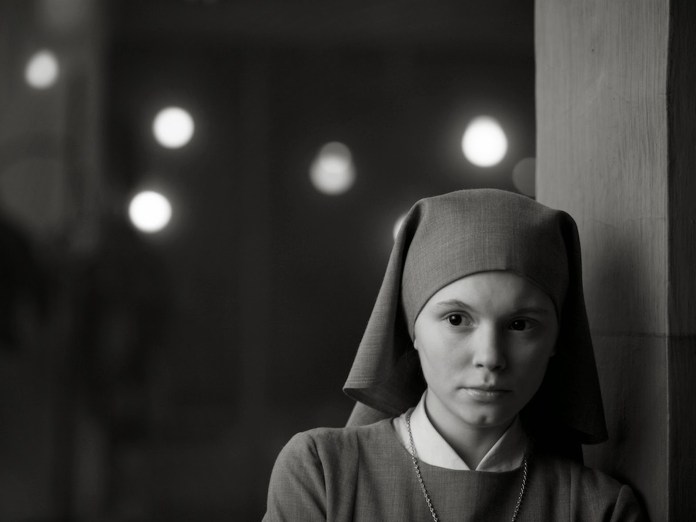
Few movies are described as “beautiful to look at.” Normally, we concern ourselves with the unfolding of a narrative and its respective sequence of events so much that we pass off something so pronounced as the quality of images presented on the screen in front of us. That’s certainly not the case in Pawel Pawlikowski’s Ida, a film that takes place in ‘60s Poland but spends a majority of its running time discussing the country’s occupation by Nazis. But rather than telling a story that takes place amidst World War II, Pawlikowski is more interested in the legacy of war on a micro level—through the perspective of an 18-year-old woman.
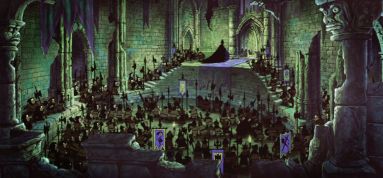
Ida is presented under a 1.33 frame with crisp black-and-white images that evoke beauty yet intrigue. The quality of the images is so crisp you can almost freeze any shot, frame it, and put it on display at a museum. The only other film that’s made me feel this type of way was Walt Disney’s Sleeping Beauty. Where the 1959 animated classic put intricate focus on landscapes by utilizing lush colors and texture that helped create Renaissance-like paintings on the screen, Ida places its focus on the people in front of the camera. The usage of a boxy frame creates this intimate look into what the characters are thinking and feeling, almost as if the filmmaker has his camera on portrait mode.

The film begins with a shot of Anna (Agata Trzebuchowska), a young novice nun who is set to take her vows, as she intensively paints a statue of Jesus—her devotion to God is evident by her eye-to-eye stance with the statue. We then accompany Anna through her day within the convent. The film’s silence is deafening for we don’t hear anything until the clanking of metal utensils as nuns slurp up their soups during dinner. Pawlikowski intentionally includes this to point out the monotony and cyclical routine of Anna’s everyday life. By placing these nuns with identical uniforms side by side slurping up the same dinner, the director paints a picture that elicits blandness—nothing is exciting as the nuns all look down to avoid eye contact, creating a world that’s seemingly isolated and out-of-touch with whatever’s beyond those walls.

Before Anna can take her vows, her prioress informs her that she has one known relative, her aunt Wanda Gruz (Agata Kulesza), and insists that she visit her. Aunt Wanda is a former judge with a high Communist Party rank. Her apparent promiscuous lifestyle combined with habits of chain-smoking and hard-drinking are enough evidence to characterize her as the foil to her sheltered niece. Wanda informs her niece that her real name is Ida Lebenstein (pronounced “ee-da”), and her parents, who were Jews, were murdered during the German liquidation of Poland in World War II. Wishing for her niece to get a sense of real life and its pleasures before her transition, Wanda sets out on a road trip with Ida. The viewer is able to see the discrepancy between the two generations thanks to the brilliant performances by the two leads. Trzebuchowska possesses these eyes that perfectly flesh out her character’s wide-eyed innocence, while Kulesza’s eyes are more tired and experienced—they have a dreadful knowledge of what the past holds for it dictates her current lifestyle.
Pawlikowski is too smart to make this movie about a generic bonding experience between two long-lost family members; instead, the movie examines the nuances within the characteristics of these contrasting women. On their voyage, Wanda picks up a hitchhiker named Lis (Dawid Ogrodnik), who happens to be a gifted jazz musician—Lis is going to a gig in the same town. With Ida’s position as the wide-eyed girl combined with the introduction of the handsome young musician into her world, there’s bound to be a spark lit up between the two and Wanda attempts to catalyze this. However, Ida ignores these acts of persuasion; after all, her first taste of the outside world is the self-destructive behavior reflected in her aunt.
Because Ida wishes to find the graves of her parents, people she never knew, Wanda takes her niece to the house they used to own and live in. Around the time of the German occupation, Wanda had left her son with Ida’s parents. However, over the course of the war, the house had been taken over by a Polish family, the Skibas, who hid the Lebenstein family from German authorities. One of the family members gives details to how he took three family members—Ida’s parents and Wanda’s son—into the woods to kill them. The only reason why Ida evaded death was the fact that she was able to pass for a Christian. And because she was an infant, she was conveniently sent to the convent. This sobering revelation is announced as they approach the burial ground and dig up the bones of their family. After taking the bones and burying them in a proper Jewish cemetery, aunt and niece go their separate ways, for they obviously feel the emotional impact of their voyage.
With their perspectives altered, Wanda and Ida resume their daily routines, but this time with a more detached viewpoint. Wanda, having connected puzzle pieces surrounding the deaths of her son and sister, falls into a depression, numbing herself with heavy drinking and sexing herself away. Ida, on the other hand, returns to the convent with a less stoic outlook as we hear her snickering amidst a slurp-infested dinner. While refreshing to see Ida break this streak of indifference we observe her in, it’s also telling that her reaction to such tragic revelations is that of a humorous perspective. Understanding her own position, Ida travels back to her aunt’s town. She encounters Lis again and decides to give in to her aunt’s suggestions of letting go—Ida dresses herself in stilettos, a gown, tries a cigarette and a drink, eventually ending the night in bed with Lis.
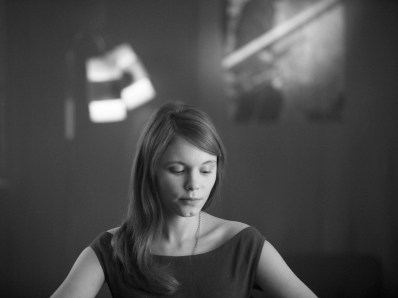
At this point, we’re happy for Ida for we anticipate an ending with a new beginning for the titular character. However, Ida’s indifference surfaces again. We observe her face as she’s in bed with Lis, and it looks unaffected—the pleasures and worldly sins that her aunt raved about have failed to evoke any awakening within her. And the final nail in the coffin proves to be the conversation that Ida has with Lis after they sleep together. When Ida asks Lis what their future holds, Lis suggests that she come with him to future shows and he proposes that they would get married and eventually have children, ultimately living “life as usual.” The next morning, we cut to Ida sitting naked in her bed. It’s almost as if her nakedness is synonymous with her identity—everything that’s guarded her up to this point has been stripped off of her, and she has been liberated. However, she decides to put on her convent habit again and leave.
The final shot deviates stylistically from the entirety of the movie. Ida is seen walking towards a hand-held camera, as it follows her to an unseen destination. This is uncharted territory because the film’s story has been told through long-lasting shots. Pawlikowski rarely moves the camera during scenes, creating light sources that highlights certain shadows of characters’ faces, and positioning figures in certain corners of a frame. Along with the dynamic hand-held camera that follows Ida in this scene, the first and only use of non-diegetic sound is incorporated in the form of Bach’s Ich ruf zu dir, Herr Jesu Christ, a title that translates to: “I call upon you, Lord Jesus Christ.” Based on the title alone, it’s appropriate to predict that she’s headed back to the convent. But it’s hard to understand why. After all, we’ve seen the stark contrast between life within the convent and life outside it. Perhaps, she’s realized there’s nothing to strive towards in the outside world. Lis promises a marriage with children, which doesn’t seem genuine as his interest in Ida borders on obsession rather than infatuation. Ida also seems to realize that life outside the convent doesn’t seem to differ too much from the one she’s grown accustomed to for the past eighteen years. If she were to go along with Lis’ suggestions, she would still fall under a routine—get married, have children, lead a mundane domestic life. Ida’s prompt departure signifies the fact that she has made a decision, one that’s been influenced by the experiences she dabbled in—experiences that soon become sacrifices once she takes her vows. As she walks down the road, the piece that begins to play almost sounds like it’s calling her name. And like a child that’s suddenly been awakened, the camera paces back and forth in rhythm with Ida’s movements, indicating how her relationship with God has been fleshed out as a result of her recent experiences—a relationship that will be defined by devotion once she returns to the convent.
Despite having the Holocaust as a backdrop to the plot of this movie, Pawlikowski is more interested in the human spirit and how it responds to tragedies of the past. Do we numb the pain away, destroying ourselves in the process? Do we enable ourselves to lead a righteous journey? For Ida, she is given closure by understanding where exactly her origins lie. Born and raised in a convent with no sense of identity, Ida is given the opportunity to seek out her purpose. In doing so, she decides on her own merits what the future holds, a significant departure from the passive character we meet in the beginning of the film. By stepping foot in 1960s Warsaw, she is able to solidify her relationship with God by expanding her horizon in a way that surpasses what she’s been taught within the walls of the church. And Pawlikowksi achieves this full circle of an ending in a way that discards common cinematic tropes, in favor of an objective viewpoint.
CONSENSUS: 4 out of 4 audible slurps
 Suntory Times