
 ©Killer Films
SPOILERS!
If you’re a New Yorker or have spent enough time in New York to classify yourself as a “New Yawker”, then you’re perhaps all too familiar with the subway scene—cooped inside an air-conditioned cart on the Q train during the apex of rush hour. Sometimes, when I sit, I let my eyes wander and spot people donning professional attire or casual graphic tees. Despite the crowded spaces filled with diverse bodies, one thing seems to bind this temporary population together: the reliance on technology. I consciously take note of the rows of pedestrians that have their heads drooping down to the palms of their hands, in which they cradle a rectangular device that serves as a portal to TV shows and highly saturated photos of other people. How easy it is to have access to the world by detaching yourself from your world.
This dramatic observation makes it that more nostalgic to watch a film like Kids. This movie, directed by photographer Larry Clark, premiered at the Cannes Film Festival in 1995 to ample controversy for its sexually explicit content and extensive drug use involving teens. It’s vulgar, and at times, hard to watch. But overall, it’s a movie about teens before the privilege of cell phones and social media took over their psyches. There’s no incorporation of technology that the teens bury their faces in; they look at each other when they are talking and thus they are more involved in the conversations they’re having.
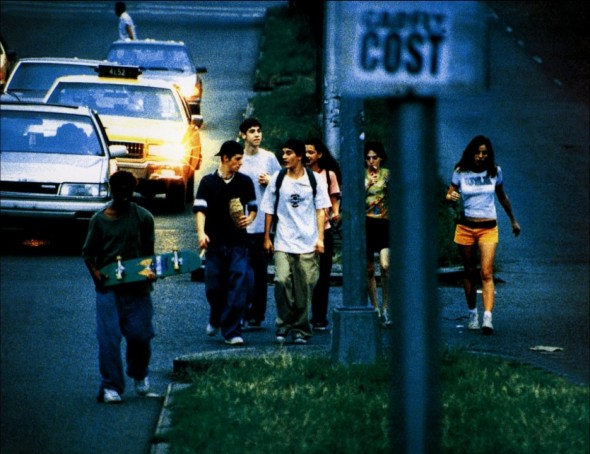
In the beginning, we are introduced to Telly, the main character played by Leo Fitzpatrick, as he boasts about his love for deflowering girls to his friend, Casey (Justin Pierce). This scene, of course, follows the introductory scene in which we actually see Telly having sex with a 12-year-old girl whom he coaxes into bed by using her naïveté to his advantage. As he recounts this heartless moment to Casper, the camera is following them from across the street with real New York City streets as the backdrop. And so, we see whatever the camera sees, giving the film a vibe that makes it reminiscent of a documentary.
Speaking of its authenticity, Larry Clark’s skills as a photographer shines through with his use of vivid colors that capture a bleakness that’s probably synonymous with the mental states of the teenagers. This, along with a cast that doesn’t scream out Hollywood, heightens the realism of the film.
Kids is also noted for launching the careers of Chloe Sevigny and Rosario Dawson, who play Jennie and Ruby respectively. We’re not introduced to them until we’re well acquainted with the central guys of the film. When the boys are talking about sex, they brag about their experiences and put themselves on a pedestal. This conversation intercuts with another conversation that the girls are having in someone else’s house. While the boys amp themselves up on one side, the girls diminish them by hilariously scolding some of their “abilities” and instead praising some of the indulgences that satisfy them instead. This miscommunication between the genders perfectly cements the film’s status as a hard-core R-rated version of a teen flick. Plus, it introduces the world to Rosario Dawson in a scene that she steals as she rants about how much she loves foreplay and “hardcore pound fucking”; her deadpan eyes and brash tone give her a maturity that is much more suggestive than her character’s age—she knows what she’s talking about and she makes sure that the camera captures it all.
 Rosario Dawson as Ruby
One would think that a movie that chronicles a day in the life of groups of teenagers would succumb to montages of incessant partying and using drugs and alcohol. However, the plot casually sneaks up on its audience just as soon as sex talk is over. We hear Ruby reference how she’s getting tested for STDs and she has asked Jennie to tag along just for moral support, even though Jennie has had sex only once in her life with—who else? —Telly. Ruby’s test is negative, but Jennie, much to her and the audience’s surprise, is tested positive for HIV. At this point, the film shies away from the emphasis on empty pleasures that the kids experience as the rest of the film has its eyes on Jennie as she tries to track down Telly to not only inform him of what he’s done, but to prevent him from passing on his poison.
The dread piles on in the film as Jennie is always a pace behind Telly. Through the film’s 24-hour time frame, we cut between Telly hunting for his next conquest as he and his friends attend a party littered with booze and drugs, and Jennie navigating her way throughout Manhattan on her own. And it’s weird to observe this transpire because this same scenario would’ve been much more condensed had it took place in the present. Today, we see technology engulf the minds of not just everyday people, but especially teens. That’s why the film feels so authentic and documentary-like, for it captures teens at a specific time in a specific place actively interacting with each other, instead of just mumbling while their heads magnetize to the screens on their phones. Of course, had the characters carried cell phones, Telly would have avoided passing on his disease to his next “victim” at the film’s conclusion. This ultimately gives the movie that unmistakably dated quality alongside a color tone that’s highly saturated and reminds me of a grunge music video on MTV.
With the lack of any prominent adults in the movie and each shot revolving around the teens, Larry Clark heightens the aimlessness of these kids by having them fill their voids with temporary moments of escape in the form of drugs and sexual release. This film is not meant to glorify or romanticize the rebellious side of growing up, but it’s meant to serve as a warning to parents and even teenagers that there are life-or-death repercussions to having no guidance as a youth.
The film’s resolution doesn’t even leave the characters with any mercy. Its final scene is a graphic and hard-to-watch scene in which Casper rapes a sleeping Jennie. And as soon as he’s done, he wanders around the party scene looking for any remnants of last night as he cleans out a bottle of beer. This ending leaves us feeling empty, almost as if whatever awaits these teenagers in the movie is nothing but a bleak future.
CONSENSUS: 3 out of 4 parental warnings
 Suntory Times