
SPOILERS!
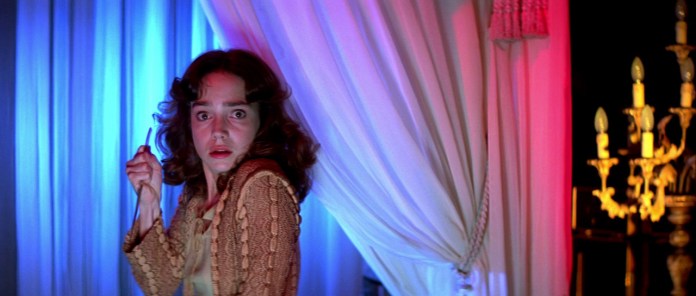
Horror has always been a film genre that’s drawn me in. For some reason, I love the prospect of getting scared while watching something fictitious. Perhaps, it’s the infinite amount of ways that a scary movie can reach out and grab you. Or maybe, it’s the lingering effect of walking out the theater after the movie’s done and feeling the numbness in your legs or the fear brushed over your skin. Whatever it is, horror films are effective and there are many adjectives that remain synonymous with them; they can be terrifying, gory, eerie, spine-tingling, unnerving, shocking, etc. All of these words can apply to Dario Argento’s 1977 classic, Suspiria, but there is one word that truly defines it: beautiful. When one talks about masterpieces, one refers to pieces of art that showcase the craftsman’s raw talent on display. Argento showcases his masterpiece by using bright and lush colors that depict a kaleidoscope nightmare. Visually, Suspiria is beautiful; the setting is beautiful, the lighting is beautiful, the cinematography is beautiful…even the death sequences are beautiful albeit grotesque. After all, It’s no surprise that Argento models this film’s color scheme after Walt Disney’s Snow White and the Seven Dwarfs.
Much like Snow White, Suspiria plays out like a folk tale—its main protagonist must evade the wrath of witches. That main protagonist is Suzy Bannion, played by Jessica Harper, who travels to Germany to attend a dance academy. As soon as she arrives at the airport, she is greeted by a violent thunderstorm that almost serves as a warning for her. At the academy, Suzy finds out the school isn’t what she expects; students are disappearing, maggots fall from the ceiling, and Suzy herself faints on her first day of class after encountering a haggard custodian lady. Suzy soon discovers the academy houses a cult of witches and she has to either survive or become its next victim. While the plot is fairly simple, each aspect of Suspiria is malicious. From the opening thunderstorm to the overly violent death scenes, this film is presented as 100 minutes of unescapable hell.
For a film that deals with such dark matter, Suspiria is surprisingly bright in color. During scenes of suspense or anticipating dread, the darkness is replaced with bright blue and red colors. The film’s first death sequence shows a frantic student, Pat, running from the academy to her friend’s apartment. The apartment is so outrageously showy that the viewer almost forgets that Suspiria is a horror movie. As Pat is lured to a window, she is smashed through it by an unseen figure and violently stabbed. One shot shows the knife being plunged into her visible heart; this shot evokes a sense of gratuitous discomfort, yet Argento continues to mesmerize the audience by juxtaposing this image with polished and inviting colors. Pat is then hung from a telephone wire and shatters through the stained glass ceiling. The colorful shattered glass combined with the bright red dripping blood paints an image that is so pleasing to the eye, but is achieved so brutally.
The film is also characterized by its juvenile vibes. As soon as Suzy enters the academy, she is greeted by instructor Miss Tanner, who is very reminiscent of Miss Trunchbull from Matilda. Miss Tanner and Madame Blanc, the vice-directress, fulfill their roles as witches from the get-go when they compliment Suzy on her youthful beauty. In addition, the other students in the academy are very petty towards the protagonist and the school itself has doorknobs positioned at the same height as the actress’ heads—a move that Argento makes in order to heighten the students’ naïveté as the actresses had to raise their arms to open the doors, just like children would. After the discovery of maggots, all of the students are forced to sleep together in the practice hall like kids at a day care. By incorporating imposing figures and architecture in the dance academy, Argento emphasizes the fear and intimidation that this nightmarish setting is able to exude.
Suspiria’s theme music is the type of music that you don’t know you know until you’ve heard it (I hope that makes sense). Composed by Italian progressive rock band, Goblin, the film’s composition is first heard in the opening scene. Starting out with a xylophone, the theme initially sounds like an innocent music box, which is appropriate to the film’s characters and setting. But as breathy vocals are incorporated, the feeling of unease sets in. Hypnotic instruments like the tabla and bouzouki are gradually added on, which make it apparent that something sinister awaits Suzy. In other scenes, Goblin uses the intense banging of drums to mimic the sound of a heart beating rapidly. It’s a terrifying assault to the ears, mainly because it pairs with the film’s ghastly imagery so perfectly and sets the audience members on the edge of their seats.
While Suspiria exceeds in garish style and atmosphere, it succumbs to formulaic horror movie tropes and a dated quality. There are so many instances where characters investigate strange noises or venture into the unknown that there is no use in counting on their survival. But perhaps that’s what Argento is aiming for—campiness. Campiness is what engulfs our nightmares; in our nightmares, we would embrace the open door or the strange noise and proceed with our investigation. The dated quality can be attributed to the use of ADR—additional dialogue recording. As was customary in Italian filmmaking at the time, the actors’ dialogue was not properly recorded, and instead, it was dubbed over; part of the reason was that each actor spoke their native language (Harper spoke English, while other actresses spoke either Italian or German) and the film was thus dubbed in English when shipped to American markets or in Italian when shipped to Italian markets. That’s why every line in Suspiria sounds so crystal clear, but that doesn’t necessarily mean it’s a good thing. Instead of having me understand what each character was saying, I felt the use of ADR made the film a bit more artificial. It’s strange to be able to hear every line of dialogue despite the loud crashes or the sudden music prevalent throughout the film.
Despite the predictability and a thin plot, Dario Argento’s Suspiria succeeds in capturing his spectacle of a nightmare on film by using lavish colors, an old-school premise, endless gore, and a creepy gothic location. And just like nightmares, the film ends with an abrupt and lingering effect.
CONSENSUS: 3 out of 4 raining maggots
 Suntory Times