

SPOILERS!
At the end of a long trip, you’re being driven to the airport to fly back home—leaving behind all the memories and stories you’ve created during the days preceding your departure. Do you ever just look out the car window and watch the buildings and pedestrians fly by you? You sit there desperately trying to soak in the atmosphere and the culture one last time before your dreaded return to reality. Director Sofia Coppola impressively captures that emotion in her sophomore feature film, Lost in Translation. The film stars Bill Murray, whose character was specifically written for him, and Scarlett Johansson, someone who brings unexpected maturity to the role despite being only 17 at the time of filming. Both of their characters seem indifferent to everything until they meet each other by chance at a Tokyo hotel bar one night.
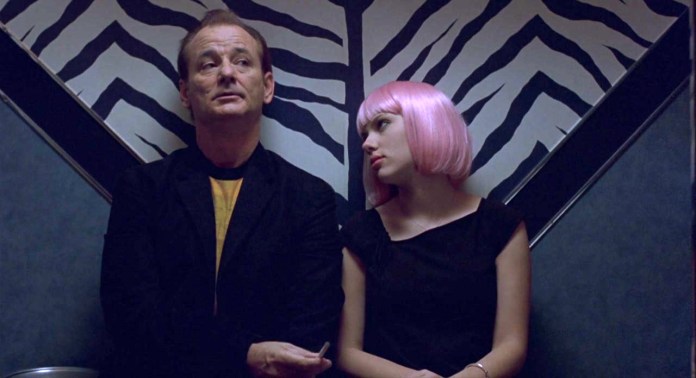
Murray plays Bob Harris, a middle-aged actor who travels to Tokyo to endorse Suntory Whiskey by shooting a commercial. “For relaxing times, make it Suntory time,” he tells the camera before being interjected by the Japanese-speaking director. The director goes off on this rant towards Harris on what to do and how to read the lines, yet the translator simply tells Bob, “…more intensity.” His marriage to his wife seems to have developed a boring pattern where he almost feels like he doesn’t want to go back home during some scenes. ScarJo plays Charlotte, a beautiful young woman with a husky voice who is unhappily married to her photographer husband. She accompanies him on an assignment in Tokyo where the Japanese signs and the jet lag leave her in a state of disorientation. Before they meet each other, we see that Bob and Charlotte are both lost. Lost in the language. Lost in the culture. Lost in their respective marriages. These two characters have so much in common that we almost expect them to have sex once they meet each other, yet they never do. Coppola is aware that these two are mature grown-ups and, with her heartfelt screenplay displaying raw feelings, she is able to bring them closer to each other more than sex ever would.
Bill Murray is sarcastic, funny, and heartwarming in a role that was meant for him. He portrays a man who is sometimes sad, but sometimes happy—especially when he’s with Charlotte or discussing children. “And they turn out to be the most delightful people you will ever meet in your life,” Murray ponders as he’s lying in bed peering at the ceiling while discussing with Charlotte the prospect of having kids. Scarlett Johansson is subtle yet powerful. She exudes this obvious affection for Bob with hypnotic glances or heart-to-heart conversations, ones that seem like she’s never had with her own husband. Not to be outdone, the supporting actors do an amazing job as well. Giovanni Ribisi plays the unlikable husband, someone who’s too caught up in his own ambitions to pay any real attention to Charlotte. But my favorite supporting role goes to Anna Faris’ portrayal of Kelly, an actress who comes to Tokyo to promote her new action film and ends up flirting with Ribisi’s character. No one plays a ditzy character better than Faris, even though she is in maybe 3 or 4 scenes.
The effortless chemistry between Murray and Johansson is on full display when they aimlessly delve into the city—attending places like karaoke parties or go-go bars. They wander through Tokyo like it’s Mars, and that’s what Sofia Coppola is trying to convey. This film is her version of a love letter to Japan, emphasizing its weirdness and quirkiness throughout the 100 minutes.
I’ve said this to my friends plenty of times and I’ll say it again—this is one of my all-time favorite movies. There’s not one genre that Lost in Translation appropriately falls under because it displays several of them. I appreciate how Coppola doesn’t let the film become too much of a formulaic rom-com, a genre that is far too familiar in the film industry. Instead, she uses the characters’ blatant honesty as well as the talent of the actors to portray a sentimental relationship that makes the lives of the two characters a little better and more promising.
In perhaps the most important and genuine scene of the movie, Bob is leaving for the airport when he sees Charlotte walking down a crowded walkway. He gets out of the car and runs to her and they share a hug before Bob whispers something ambiguous into Charlotte’s ear. With the camera angles focused on each character’s face, we can tell that it’s something meaningful and it rightfully is because Coppola never discloses what he whispers into her ear. It’s something sacred that should be kept between them because they deserve their solitude. Right before he leaves, he gives her a kiss goodbye and hugs her one last time. As they depart, Just Like Honey by the Jesus and Mary Chain begins to fill the background noise as we sense that the lives of these two characters resume back to their original lifestyles. And it’s this feeling that I touched upon in the beginning of the post when you’re leaving for the airport that everything starts to crumble back to reality. Honey conveys this melancholy feeling perfectly and Coppola ends it on a somber yet beautiful note.
CONSENSUS: 4 out of 4 bottles of Suntory
 Suntory Times